Jalen came home from the first week of fall camp with a red mark across his hip bone and a girdle that had rotated about a quarter turn by the end of practice. Nothing was torn and nothing was broken. The padding was just sitting somewhere other than where it needed to sit, and an integrated girdle that fits wrong does that quietly, on every rep, until a hip pointer shows up in week three and nobody can explain it. The one we hand out of our team equipment bin, the Sports Unlimited Omaha 7 Pad, is a solid piece of gear that gets blamed for a sizing mistake at least once a season. The waistband number is the easy part. The part that decides whether you get protection or a bruise is where the pad panels land once the girdle is on a body that is bent over in a stance.
Here is what most parents do, and I did it too the first time: they read the player's jeans size, order that, and hand it over in the parking lot. Then the kid wears it for a week, the thigh pads creep toward the outside of the leg, the tailbone pad rides up above the belt line, and everybody decides the girdle is cheap. It usually is not cheap. It is usually the wrong band on the chart. The Sports Unlimited girdle is a pull on compression layer worn under padded football pants, with padding at the hips, thighs, knees and tailbone and a cup pocket that does not come with a cup. Simple gear. Easy to mis-size by one band, and one band is enough to move a pad off a bone.
Measure once in August instead of three times in October
The Sports Unlimited Omaha 7 Pad runs from S at 28 to 30 inches up through 4XL. Put a real waist measurement against the chart before you order.
Amazon Check Today's Price on Amazon →What the Size Chart Is Actually Asking For
The listed adult sizing runs S at 28 to 30 inches, M at 30 to 32, L at 34 to 36, XL at 38 to 40, XXL at 42 to 44, 3XL at 44 to 46, and then 4XL. Notice two things about that. First, these are waist measurements, not pants sizes and not the number printed inside a pair of athletic shorts. Second, there is a gap between M and L, from 32 to 34 inches, where no band is listed at all. That gap is where a lot of returns come from.
The chart is asking for circumference at the waistband line, taken on skin or over a thin base layer, with the tape level all the way around. That is the only number the bands care about. Height, weight and the size of a player's thighs are useful context, and none of them override the tape. A 210 pound lineman with a 34 inch waist and a 165 pound receiver with a 34 inch waist take the same size, because the compression fabric does the work and the pads are positioned by the band that waist puts you in.
Step 1: Measure the Waist Where the Padded Pants Sit
Have the player stand relaxed with his feet even, and find the top of the hip bone on both sides. The waistband of his padded pants sits somewhere between that point and the navel, and that is the line you measure. Not the line where his jeans sit. Not the line where his school shorts sit. Tape snug against the body, level front to back, and he should be able to take a normal breath without you loosening it.
Measure twice, and have a second person read the tape. A player holding his own tape measure tends to suck in and pull the tape tight, and both of those cost you half an inch, which is exactly the margin you are trying to nail down. Write the number down. Do not do the arithmetic in the car from memory. If the number lands at 32 and a half, write 32.5 and keep it.
Two more measurements are worth taking while the tape is out, even though the size chart does not use them. Measure around the widest part of the thigh, and measure from the waistband line down to the middle of the knee cap. Those two numbers tell you whether a given band will sit where it should on this particular player, and they make the check in Step 3 much faster. It takes about thirty seconds and it saves a return.
Step 2: Pick the Band You Land In, and Deal Honestly With the Gap
If the measurement falls inside a band, take that band. If it lands exactly on a boundary, say 30 inches between S and M, take the larger of the two, because a compression girdle that is too tight rolls at the waist whenever the player bends, and a rolled waistband drags the whole pad line up with it. The adjustable straps will take up a little slack. They will not add length to a waistband that is cutting in.
Then there is the 32 to 34 inch hole. A player who measures 33 has no band that was written for him. My advice after watching this go both ways: take the L at 34 to 36 and let the adjustable straps and the compression do the rest, rather than squeezing into an M that tops out at 32. An M on a 33 inch waist will hold, and it will also crawl down every time he gets up off the ground, and a girdle that keeps getting pulled back up is a girdle whose pads keep moving.
If the measurement comes back over 46 inches, the listed bands stop at 4XL and the chart on the listing is the place to check the current top of the range. Do not guess upward from the 3XL. Order off the number you wrote down, and if the player is right at the top of a band, expect the fit to be snug for the first week and correct after that.
Step 3: Check Pad Position in a Stance, Not in a Mirror
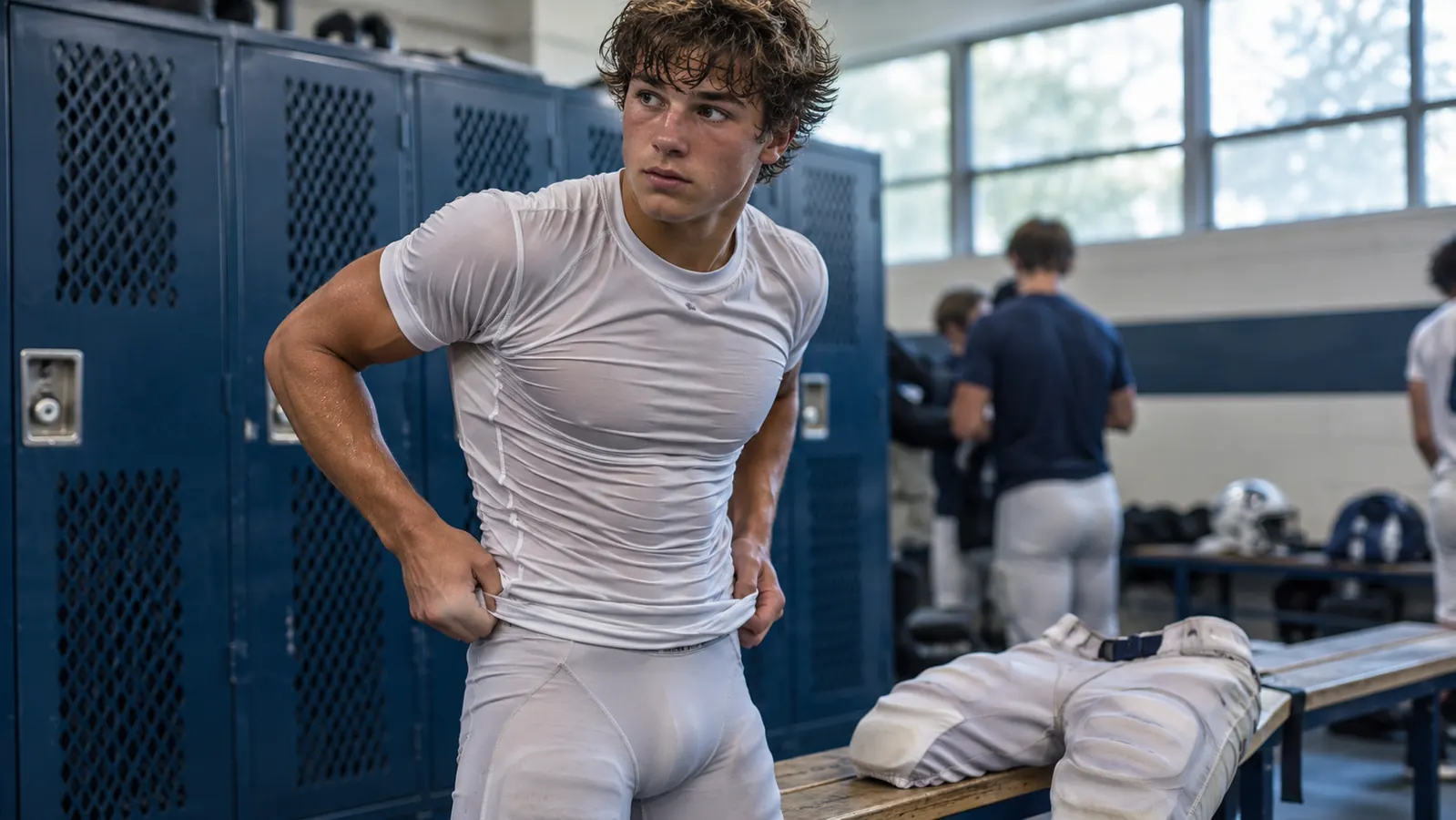
Pull the girdle on and have the player stand up first. The tailbone pad should sit centered at the base of the spine, the hip pads should cover the hip bones themselves, and the thigh pads should be on the front of the thigh. If the waistband is up around the navel, the whole pad line is an inch or two high, and the knee pads will end up above the knee cap once he moves.
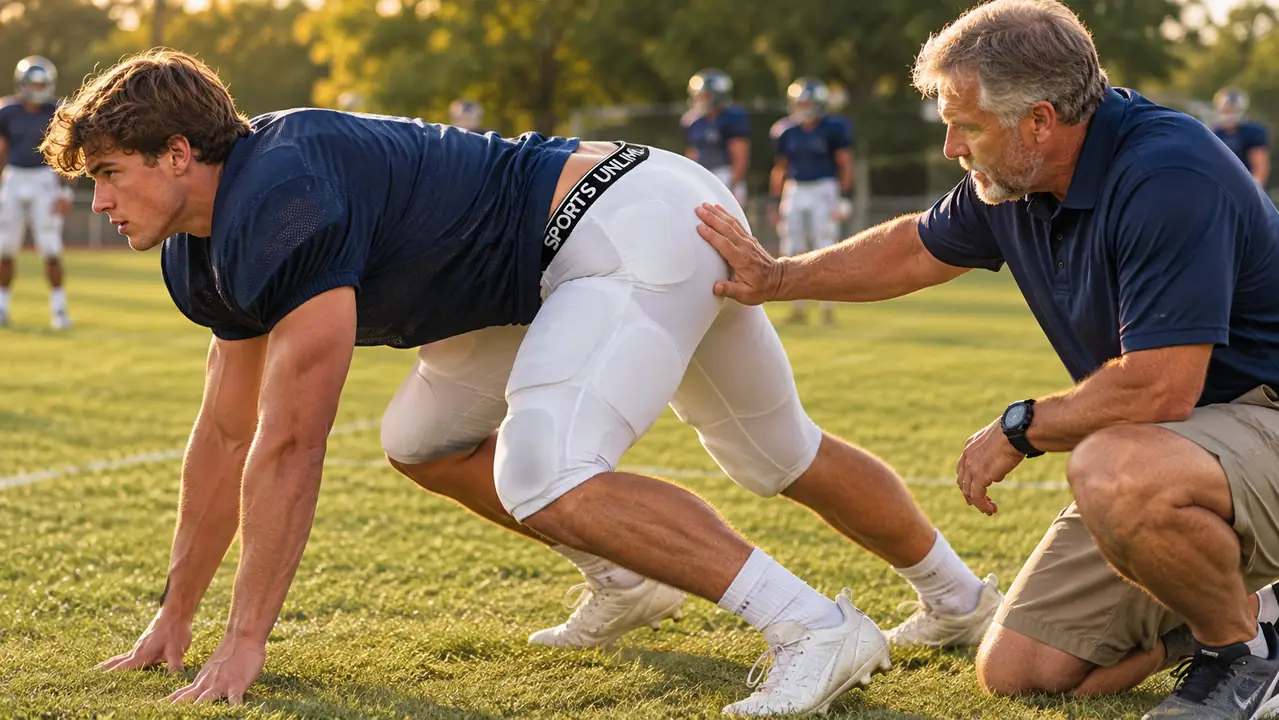
Then get him into a three point stance and look again. This is the check that matters and it is the one almost nobody does. Bending at the waist moves the tailbone pad down and back, and it moves the front thigh pads up relative to the skin. Have him put a hand down, get set, and then look at the knee pads. If they have climbed off the knee cap, the girdle is too long in the body for him, and going down a band is a better fix than tugging the legs down all day.
Last part of this step: check the cup pocket. The Sports Unlimited listing is clear that a cup is not included, so the pocket is empty until you buy one, and an empty pocket does not protect anybody. Put the cup in, get him back into his stance, and make sure it stays where it was put and does not slide sideways. If it slides, the pocket is sitting too low or too high on him, and that is another argument for a different band.
Step 4: Layer the Padded Pants Over It and Re-Check Everything
The girdle goes on first, the padded pants go over it, and the two have to agree with each other. Pull the pants up and check that the pants waistband sits over the girdle waistband, not under it. When the pants waistband sits below, the girdle edge shows, the pants pull the girdle down as he runs, and the pad stack ends up in two layers that fight each other all night.
Some padded pants come with their own built in pads at the hips and thighs, and stacking those on top of integrated girdle padding is double thickness in one spot and nothing in another. If that is what you have, look at where the two pad sets overlap and decide which one is doing the job. Usually the pants pads come out and the girdle does the work underneath, which is the whole point of an integrated girdle.
Check the knee area last. The bottom hem should finish above the knee cap so the pads can sit on it, not across it, and the pants should not bunch at the back of the knee when he bends. Bunching there is a fit problem, and it shows up as a kid tugging at his pants between every play, which coaches notice and which is a fair sign the waist is wrong.
Step 5: Test It in Motion, Then Look Again Ten Minutes Later
Standing checks catch gross errors. Movement catches the rest. Have the player do a set of sprints, a set of down starts, a pass set if he plays on the line, and then get up off the ground five or six times the way he would after a tackle. Ten minutes of that will tell you more than twenty minutes in front of a mirror, because the forces that move a pad are the ones that happen while he is moving.
Then look at the pad lines again. The hip pads should still be on the hip bones, the thigh pads should still be on the front of the thighs, and the waistband should still be where it started. If the waistband has dropped an inch, the girdle is loose or the pants are pulling it down. If it has rolled over, the band is too tight. Either way you learned it in the driveway instead of in the second quarter.
Do the same check after the first full practice and again after the first week. Compression fabric relaxes a little with wear, and a girdle that was snug on day one is often correct by day seven rather than too loose. If it is still moving after a week of real practices, the band is wrong and no amount of adjustment will fix it. Measure again, because a fifteen year old can change an inch over a summer.
A girdle that is one size off does not feel wrong standing up. It feels wrong in a three point stance, which is the only place it matters.
What Else Helps
Buy the cup at the same time. The Sports Unlimited listing says plainly that the cup is not included, and that is the single most common thing a parent discovers on the way to the first game. A cup that fits the pocket properly is worth the extra trip, and it is a lot easier to sort out on a Tuesday night in the garage than it is in a parking lot twenty minutes before kickoff.
Two girdles per player is not a waste for anyone playing twice a week. One goes in the wash, one goes in the bag, and nobody is doing laundry at ten at night. This is the piece of gear that spends the most time against skin, and having a second one also lets you compare how the first has relaxed after a month, which tells you whether the size was right to begin with.
The rest of the fit chain matters too. A mouthguard the player will actually keep in his mouth is part of the same conversation, and so are the padded pants themselves. If you are deciding between an integrated girdle and a pair of padded pants with built ins, the honest answer depends on how much layering the player will tolerate in August heat in Tennessee. I wrote both of those out separately and the links are at the bottom of this page.
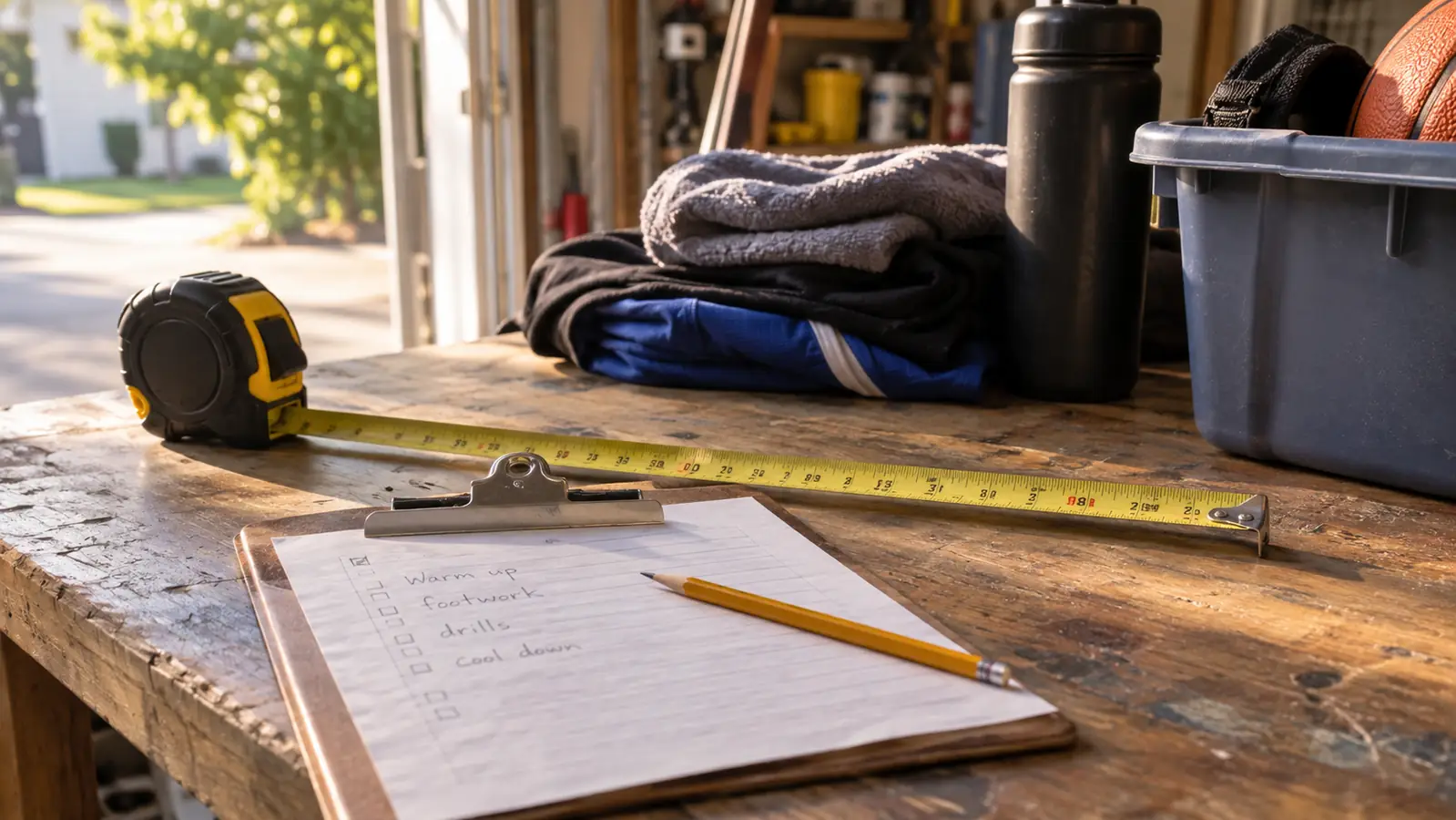
One low cost habit that saves a lot of grief: keep a cloth tape measure in the equipment bin. The gray pickup already hauls that bin to practice twice a week, and a tape measure in the lid means you can settle a sizing argument in the parking lot with a number instead of an opinion. Measure in August before the season, and measure again in October, because a player can put on ten pounds in nine weeks without anyone noticing.
Where This Girdle Falls Short
On the Sports Unlimited Omaha 7 Pad the tradeoff is the pull on closure. There is no waistband adjuster, so the fit is set by the band you order and the adjustable straps can only do so much. That is fine when the size is right and annoying when it is not. The gap in the chart between M and L is a real gap and it catches players in the middle of it. And the fabric will relax over a season, which is normal for compression gear and still means the fit in November will be looser than the fit in August.
It also does not replace the pants. This is a layer worn underneath padded football pants, not a substitute for them, and a player who thinks he can skip the pants because the girdle has pads is going to be under protected in exactly the spots the girdle does not cover. Used the way the listing describes, under the pants, with a cup in the pocket, it does what an integrated girdle should do. Used any other way, it is a compression short with some foam in it.
Get the band right and the pads follow on their own
Take a waist measurement at the pants line, write it down, and match it to the chart before you order. The Omaha 7 Pad runs from S at 28 to 30 inches through 4XL, with a pull on fit and adjustable straps.
Amazon Check Today's Price on Amazon →