

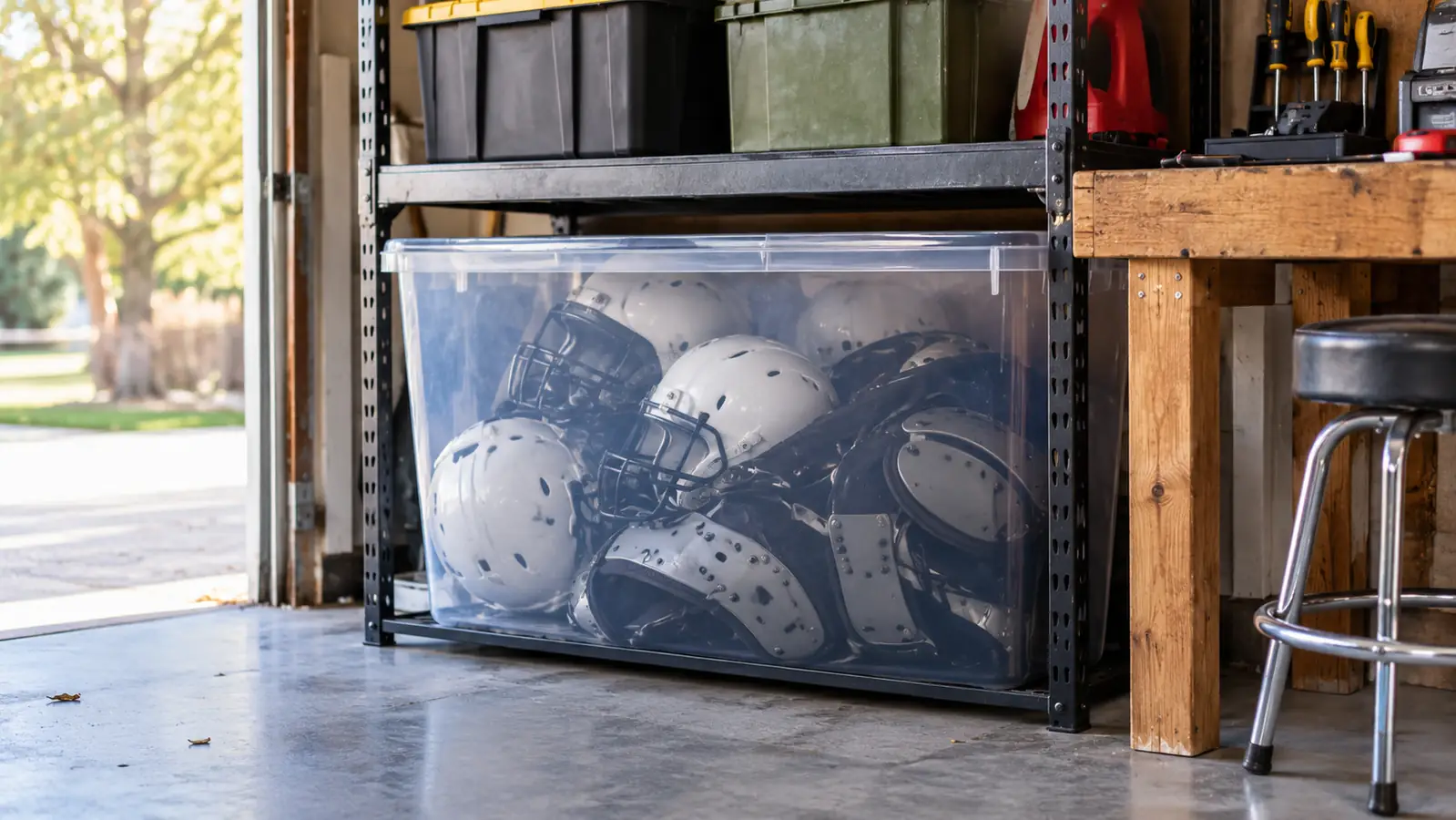
By the third week of fall practice I had a plastic tub in the garage with eleven mouth guards in it. Nobody throws them away. They just stop going back in. Every one of those eleven came out of a kid's mouth for one of three reasons: it rubbed a gum raw, it made breathing feel like work, or it stopped fitting right somewhere around week two. So when our equipment guy handed me a Shock Doctor Gel Max and told me to try it on the JV line, I figured it would be in the tub by September.
It was not. The Gel Max made it to the last whistle in November, still in a mouth, still doing its job. I ran it through a full season with our junior varsity line and with Jalen, my fifteen-year-old sophomore who plays linebacker and treats gear the way teenagers treat everything, which is to say he chews on it. Here is what held up, what did not, and who I would hand one to.
The Quick Verdict
Fits fast, breathes better than most, and survived a full JV season. It loses points on chewing damage and on how quickly a growing kid outgrows the fit.
Amazon Check Today's Price →The One Guard That Made It to November
Eleven guards quit on my team by week three. The Shock Doctor Gel Max did not. If your player is already on his second guard of the season, start here.
Amazon Check Today's Price on Amazon →How I've Used It
I am not a professional tester. I am 47, I coach the JV line at a high school in Chattanooga, and I played offensive line at a small college where the mouth guards came out of a cardboard box and nobody asked follow-up questions. My qualification is that I have watched a few hundred kids put plastic in their mouths, and I can usually tell within one practice which ones will keep it in and which ones will be working it around like a piece of gum by the second water break.
We ran the Gel Max from the first two-a-day in August through the last Friday night in November. It got used at the school practice field, in my backyard when Jalen and I worked on hand placement, and in the garage where I keep the spare equipment bin. It rode to practice in the back of my gray pickup in that same bin, in Tennessee heat that turns a closed truck bed into an oven. If a piece of plastic is going to warp or go soft, that is where it happens.
The first real test came on the second Saturday in August, when the temperature hit 94 by ten in the morning and we ran a two-hour practice in full pads. I had fitted four guards that morning on the tailgate of the truck and set them on a towel to cool. Two of the four came back to me at the water break saying the guard felt slick. That is a fitting problem, not a guard problem, and it is the reason I now fit them indoors at a table instead of outside in the heat.
The test group was our JV line plus a handful of skill guys who asked to try it, plus Jalen at linebacker. That gave me a decent spread of mouth sizes and a decent spread of attitudes. The linemen mostly leave gear alone. The skill guys lose everything. Between the two groups I got a real read on both the durability question and the losing-it question, and both answers turned out to matter.

The Fit: What the Gel-Fit Liner Actually Does
Shock Doctor builds this guard around a gel liner they call Gel-Fit, and the whole point of it is that fitting is quick and does not require an equipment manager with a hot plate and a stopwatch. I fitted about a dozen of these. The liner softens and molds to the shape of the teeth, and the process runs about five minutes per player once you have done one and know the order of operations. Follow the instructions in the box exactly. The kids who rushed it are the same kids who came back a week later saying it felt loose.
Before the Gel Max, our team was using the standard guards out of the team box, and the failure was always the same. A kid would bite down too hard on hot plastic, the guard would set thin at the front, and by the second week it would slide. I tried the obvious fix first and refitted the same guard a second time. It does not work. Once that liner has set, you are not molding it again, you are just making it worse. The gel liner on this one is more forgiving of a rushed first attempt, but the lesson held for our whole roster: the first fitting is the one that counts.
When it is fitted correctly, the guard sits on the upper teeth and stays put without a strap. That matters more than it sounds. A lot of our guys came up wearing strapped guards, and a strap is a leash, not a fit. It keeps you from losing the thing, but it does not keep it comfortable. The Gel Max does not use a strap, so the fit has to do all of the work by itself, and on most of our players it did. The ones who had trouble were the ones who hurried the fitting.
The fit is also where the honest complaints come from. A guard molded to a fifteen-year-old in August is molded to a fifteen-year-old who will be a slightly different fifteen-year-old by November. We refitted three players mid-season, two of them because of braces adjustments. None of those refits failed. But it is a reminder that for a growing kid this is a seasonal piece of gear, not something he keeps until he graduates.
Breathing and Talking, Which Is Most of the Job
The integrated breathing channels are the reason the Gel Max stayed in mouths on our team. Let me be precise about what that means in practice, because I have read enough gear reviews to know when a feature is being oversold. It does not mean your player can sprint like he is not wearing anything. It means he is not fighting the guard for air between plays, and he is not ripping it out at the end of every series because he feels like he is suffocating. That is the bar, and this guard clears it.
Offensive line is where this shows up fastest. We are in a three-point stance, we are getting up and down twenty times a series, and we are talking to each other the entire time about assignments. A guard that muffles a kid into silence is a guard that costs us a protection call. With the Gel Max in, I could understand our center calling the front from four yards away, which is not a small thing when the varsity staff is standing behind you taking notes.
The comparison I keep coming back to is a scrimmage in the third week of September against a team that blitzed on nearly every down. Across the sideline, their linemen were pulling guards out between snaps and holding them in their hands while the call came in. Ours were not. I counted sixteen straight snaps where our five linemen kept the same guard in from huddle to whistle. That is the whole argument in one number: a guard that stays in is doing its job, and a guard in a kid's hand is not protecting anything.
Jalen noticed it on defense, which surprised me. Linebackers talk more than people assume, and he said he could make the check call without pulling the guard out first. That is the entire argument for this product in one sentence. A good guard that a player leaves in is worth more than a better guard that spends the fourth quarter in his hand.
Durability: A Full Season in the Equipment Bin
Here is where the review gets honest. The Exoskeletal Shock Frame, which is what Shock Doctor calls the outer structure of the guard, held up fine on the players who left it alone. Nine of the twelve we fitted finished the season without a tear. That is a good rate for a thin piece of plastic that lives in a hot bin and gets thrown in a helmet bag five days a week.
Three did not make it cleanly. All three belonged to chewers. If your player works a mouth guard like a piece of gum, he will eventually chew through the liner on any brand, and the Gel Max is no exception to that. One of the three was Jalen, which tells you something about my own house. The liner started separating at the edge, and by the last week he was asking for a new one. It never failed while he was wearing it, but I would not have started a playoff game with it in his mouth.
The failure showed up in a specific way. Around the first week of October I noticed the liner on Jalen's guard lifting at the front edge, right where he clamps down when he is set. It was small enough that he did not mention it. By the last week of October it had lifted maybe an eighth of an inch, and that was the point where he started working it with his tongue between plays. That is exactly the behavior the guard is supposed to prevent, and it came from wear rather than from design.
The other thing worth flagging is that the guard is light, about a gram, and thin enough that a kid can genuinely forget he is wearing it. That is a benefit right up until the moment he takes his helmet off and it goes into a pocket and then into the laundry. Expect to lose one or two over a season across a roster. That is a roster management problem rather than a product problem, but it is real, and any coach handing these out should plan for it.
Nine of the twelve we fitted finished the season without a tear. The three that did not belonged to chewers, including my own son.
The Flavor Detail, and the Small Stuff
Each color variant of the Gel Max carries its own flavor. I am 47 years old and I find this strange. The fifteen-year-olds in my huddle do not. I had two players ask me which one tasted better, which is a conversation I did not expect to have as a volunteer coach on a Tuesday afternoon. But if a flavor is what gets a kid to keep the guard in his mouth instead of palming it, then the flavor is doing real work, whether or not it makes sense to me.
It is latex free, which our athletic trainer cares about and I now care about, because we have a couple of players on the roster with latex sensitivity and it is one less thing to verify at equipment check. The guard is also listed for wrestling alongside football, hockey and boxing, so the intent here is a general contact sport guard rather than something built for one specific game.
The dimensions are small, roughly four inches by two, which means it drops into a helmet bag or a pants pocket without needing its own case. That sounds like nothing. It is not nothing. The single biggest factor in whether a kid has a mouth guard at the field is whether it is easy to carry, and this one is.
What I Would Change
Two things. I would put a way to mark it on the guard itself, because we burned ten minutes before one game sorting out whose was whose among four that looked the same in a helmet bag. And I would like the liner to hold up a little longer against a determined chewer, though I understand the physics of that request and I am not holding my breath waiting for it.
What I Liked
- Fits in about five minutes per player with the Gel-Fit liner, fast enough to do a whole JV roster in one afternoon
- Integrated breathing channels keep it in the mouth between plays, which is the real measure of a guard
- Nine of the twelve we fitted survived a full season without a tear
- No strap to fiddle with, so the fit does the work and nothing dangles off the facemask
- Latex free, which matters if your roster has sensitivities
- Light enough that players forget they are wearing it
Where It Falls Short
- Determined chewers will separate the liner, and no clever engineering prevents that
- A growth spurt or a braces adjustment mid-season means a refit or a new guard
- Nothing on the guard to mark it, so identical guards get mixed up in a team setting
- The flavor variants sell to teenagers and confuse adults
Who This Is For
This is for the parent of a youth or high school player who is tired of buying guards that end up in a pocket by the second quarter, and for the adult rec player who wants something he can breathe through for a full game. It also makes sense for the coach who ends up handing these out, because the fitting is quick enough to do twelve in one afternoon without losing your Saturday.
Who Should Skip It
If your player is a serious chewer, plan on replacing it mid-season and set your expectations accordingly. If he wears braces that get adjusted during the season, expect at least one refit. And if you need a guard that clips to the facemask so it physically cannot be lost, this is not that product. Go look at the strapped version instead of fighting this one, because a strapless guard depends on the fit and a strap depends on the clip.
One Guard, One Season, No Tub
The Shock Doctor Gel Max is the first guard in three years that finished a season in a player's mouth instead of in my garage. Fit one before your next practice and see whether it stays in.
Amazon Check Today's Price on Amazon →