

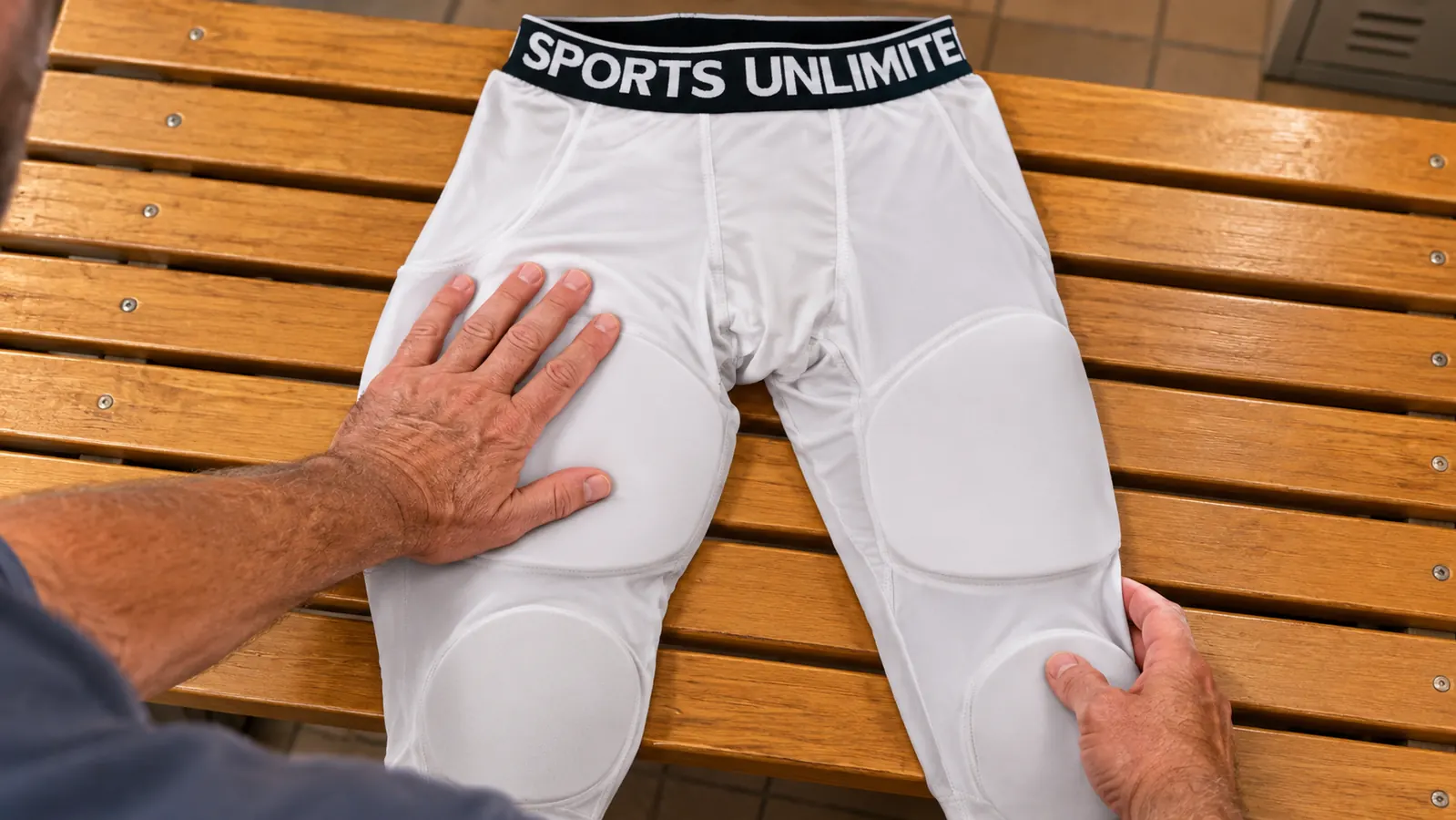
The first thing I noticed about the Sports Unlimited Omaha 7 Pad girdle was not the padding. It was the heat. Jalen pulled it on in the garage on a Tuesday in August, walked to the end of the driveway and back, and by the time he came inside the back panel was damp through. He looked at me and said, "Coach, this is going to be rough in September." He was right about September. He was also right that he kept wearing it anyway. What follows is the honest version of that first season, the parts the product page does not lead with: how hot it runs, how the sizing works against a tall kid, why the pad count in the listing does not agree with itself, and why he still reaches for it on Friday nights.
I coach the JV line at a high school here in Chattanooga, and I played offensive line in small college, so I have worn a girdle through an August myself. I am not writing this to bury the thing. A 4.4 average across more than 1,200 reviews is not an accident, and the Sports Unlimited girdle does the core job, which is to put padding under the pants at the hip, thigh, knee and tailbone without adding bulk. What I want to give you is the version I would give a parent in the parking lot after practice, because the tradeoffs are real and they are predictable.
The Quick Verdict
Real padding in the right places and a compression fit that stays put, but it traps heat under padded pants and the waist chart leaves a gap that tall, lean players fall straight into.
Amazon Check Today's Price →Read the waist chart before you pick a size, then check today's price
Sizing is the complaint I hear most from parents, and it is the one thing you can settle before you order. Find the size you think you need, read the sizing section below, then look at today's price.
Amazon Check Today's Price on Amazon →How This Got Tested
Jalen is fifteen, a sophomore, and he plays linebacker at roughly five foot eleven and 155 pounds. That detail matters more than it sounds like it should. A girdle is the one piece of football equipment where a lean frame and a long torso change the fit more than the waist measurement does. He wore the Sports Unlimited girdle under padded pants for a full JV season, two practices a week plus a game, plus the work he does on his own in the backyard.
The first fitting happened in the garage on a Sunday afternoon with a tape measure and a clipboard, mostly because I did not trust a chart I had already read twice. Jalen stood against the workbench while I ran the tape around his waist at the navel, then again at the top of the hip bone, because those two numbers are not the same and the chart only asks for one of them. The first measurement came back at 31 inches. The second came back at 33. I wrote both down, we ordered the medium because the chart says medium for a 31, and that decision is the one I would take back if I could. The two week experiment that followed is the reason the sizing section below runs as long as it does.
My method was less scientific than that makes it sound. I checked the padding by hand the way I check everything, pressing at the hip points, the thigh, the knee and the tailbone, then watching where it sat after he had been in a three point stance for an hour. I asked him the same three questions after every practice: does it move, does it rub, how wet is it. The answers were consistent enough over a season that I trust them.
The other thing I did was hand it to two other players on the line, one smaller and one noticeably bigger, to see whether the fit problems belonged to Jalen's frame or to the garment. That comparison is where most of the sizing section below comes from. One player tells you whether something works for him. Three tell you what the garment was actually designed around.
The Heat Is Real, and It Is the Main Tradeoff
Here is the part that does not make the bullet points. A compression girdle with integrated padding worn underneath padded football pants is two layers of fabric over your hips and thighs, and in a Tennessee August that heat has nowhere to go. The listing calls the garment lightweight, and it is, in the sense that it does not feel heavy in your hand. That is not the same as cool on a ninety degree afternoon with pads over it.
Put a number on it, because vague complaints about heat are useless to a parent reading this in July. Our first Saturday scrimmage in early September kicked off at ten in the morning with the temperature already at 91 and the humidity worse than the temperature. Jalen came off after the second series with the back panel soaked through and his pants sticking to his thighs. He did not say a word about it. He just pulled at the waistband, which is what he does when something is bothering him and he does not want to be the kid who complains. That is the actual failure mode here: it does not hurt, it just accumulates, and a fifteen year old will not always tell you.
Jalen's least favorite part of two-a-days was not the running. It was peeling the girdle off afterward. He started packing a second one in his bag, which is what most of the varsity linemen already do, and that solved most of the problem. We built a routine around it. Cold wash, no dryer, hung over the porch rail to dry, and a spare in the bag on any day with two sessions. The elastic and the fabric came through a whole season of that without stretching out or pilling, which tells you something about how it is built. If you are buying for a player who practices once a day in a cooler part of the country, this may never come up. If you are in the South in August, plan for two.
By the end of a two hour practice his back panel was damp through. He started packing a second girdle, the same way the varsity linemen already do.
The compression fit is what makes the tradeoff worth it for a lot of players. It holds the pads tight against the body so they do not shift when the player goes to the ground, and it does not bunch up under the pants the way a loose separate pad set will. Jalen said the hip pads stayed put through a whole game, which is more than he could say for the pads that came with his first pair of football pants.
The Sizing Runs on Its Own Logic
This is the section I would read twice. The waist sizing runs small at 28 to 30 inches, medium at 30 to 32, large at 34 to 36, XL at 38 to 40, XXL at 42 to 44 and 3XL at 44 to 46, with a 4XL above that. Look at the jump from medium to large. Nothing in that chart covers 32 to 34 inches. If your player measures 33, you are choosing between a medium that will be tight and a large that will be loose, and neither answer is comfortable.
Jalen measured 31 at the start of the season, which put him in a medium by the chart. The medium fit his waist. It did not fit his rise. He is long in the torso, and the girdle pulled down at the hip every time he got into a stance, which dragged the knee pads low and had him tugging at them between plays. I gave it two weeks of practices before I admitted the chart had won. We went up to a large, and the waist was loose enough that he had to run the adjustable strap in to take up the slack.
Here is how the three-player comparison shook out. The smallest of the three, a guard at about five foot five and 130 pounds, took a small and had no complaint at all, because his torso matched what the garment assumes. The biggest, a tackle around five foot nine and 210, took an XL and said the waist was right and the thigh pads sat slightly high on him. Jalen, at five foot eleven and 155, was the only one who could not be fitted cleanly, and it was not his waist that caused it. It was the distance from his waist to his knee. A medium put the knee pads above the joint. A large put them where they belonged and left the waist loose enough to need the strap. If your player is built like the guard or the tackle, you will read this section and wonder what I am carrying on about.
That is the sizing complaint that shows up in review after review, and it is not really a defect. It is a garment cut to a standard waist measurement and a standard torso length, and a tall, lean kid is neither of those things. My advice for a parent is to measure the waist, then look at how long your player's torso runs relative to his height. If he is long, plan to size up and use the strap instead of fighting a tight fit for four months.
The Pad Count Is Confusing, and That Is on the Listing
The product title says seven pad. The first line of the listing description says ten pad integrated design. Both of those sit on the same page, and I cannot tell you which one is right, because the line that actually describes placement names four areas: hips, thighs, knees and tailbone, plus a cup pocket that does not come with a cup. The number is the least useful thing on the page.
What I can tell you is what my hands found and what Jalen felt. There is padding at the hip points, along the outside of the thigh, at the knee and across the tailbone. That is the protection a linebacker actually needs when he goes to the ground. I would tell any parent to ignore the count and read the placement, because the placement is what protects your kid and the count is a line somebody wrote to fill a bullet.
What It Does Well Once It Is On
The pull on closure sounds like a small detail until you have watched a fifteen year old try to fasten a girdle with straps at seven in the morning. There are no snaps to line up and no belt to thread through. He steps in, pulls it up, checks that the knee pads are sitting where they should be, and he is done. On a cold morning before a JV game that is worth more than it sounds.
It earned its keep on a morning in late October when we had to be at the field at 6:40 for a JV game and the temperature was in the forties. I watched a kid two lockers down fight a strap style girdle for a solid three minutes, which is three minutes he did not spend getting his shoulder pads seated. Jalen stepped in, pulled it up, ran two hands over the knee pads and was finished. Small thing. It is not a small thing at 6:40 in the morning. The compression fit showed up the same way during a goal line period in the middle of the season, when he went to the ground four times in about ninety seconds and came up with the hip pads still where they started. I checked them myself after that drill, because pad migration is the thing I actually care about.
The padding itself has held up. Across a full season of practices and games the tailbone pad is still where it started, the hip pads have not migrated, and the fabric at the knee has not worn through even though that is the spot that takes the most abuse. The garment measures 15 by 12 by 1.5 inches, and it folds down small enough to live in the equipment bin in the back of my gray pickup without taking the bin over.
One more thing the Sports Unlimited girdle does well is disappear. Jalen wore it under standard padded football pants all season and you could not tell from the sideline that he had anything extra on. For a player who is self conscious about looking bulky, that matters more than any number on the product page.
What I Would Look At Instead
If your player runs hot and you are shopping in July, the honest alternative is a lighter compression short with separate pads you position yourself. You give up the integrated knee and tailbone coverage, and you gain airflow and a fit you can adjust. That is a real trade and it depends on how much your player complains about the heat versus how much you worry about his tailbone.
The other alternative is padded pants with the pads built in, which removes a layer entirely. The catch is that built in pads shift more than a compression girdle does, and once the pants wear out you are buying the pads again. I have watched both setups go through a season on the same line, and neither one is obviously better. It comes down to which annoyance your player will tolerate.
What I Liked
- Padding at hips, thighs, knees and tailbone without bulk under the pants
- Compression fit keeps the pads from shifting when the player goes to the ground
- Pull on closure means no snaps or belt to line up before an early practice
- Held up over a full JV season with no pad migration and no wear at the knee
- Folds down small enough to live in an equipment bin
Where It Falls Short
- Traps heat under padded pants, which is the main complaint through August
- The waist chart skips 32 to 34 inches, so some players land between sizes
- Long torso players will need to size up and run the adjustable strap in
- The cup pocket is there but no cup is included
- The listing gives two different pad counts on the same page
Who This Is For
This is for the player who wants integrated padding under his pants and does not want to think about it again. It suits a stocky or average build best, because the waist chart assumes a standard torso. It suits a player who practices once a day in a cooler part of the season, or a family willing to buy a second one. And it suits a parent who wants hip and tailbone coverage without buying and fitting a separate pad set.
Who Should Skip It
Skip it if your player is long in the torso and lean, unless you are ready to size up and run the strap in. Skip it if you are in a hot climate and only buying one, because you will be washing it every night. Skip it if your player already has padded pants with pads he likes, since the girdle then becomes a second layer he does not need. And skip it if you need a cup included, because the pocket is there and the cup is not.
The one thing worth doing before you order
Measure the waist, then look at the gap between medium and large on the chart. If your player falls inside it, order the larger size and take up the slack with the strap, and check today's price while you are there.
Amazon Check Today's Price on Amazon →