

Jalen came home from his first JV practice last August with his mouthguard in his sock. Not his helmet, not his gear bag. His sock. He had spit it out at the whistle, could not find it in the grass, and spent the last forty minutes of practice with it wedged against his ankle so he would not have to tell me he lost another one.
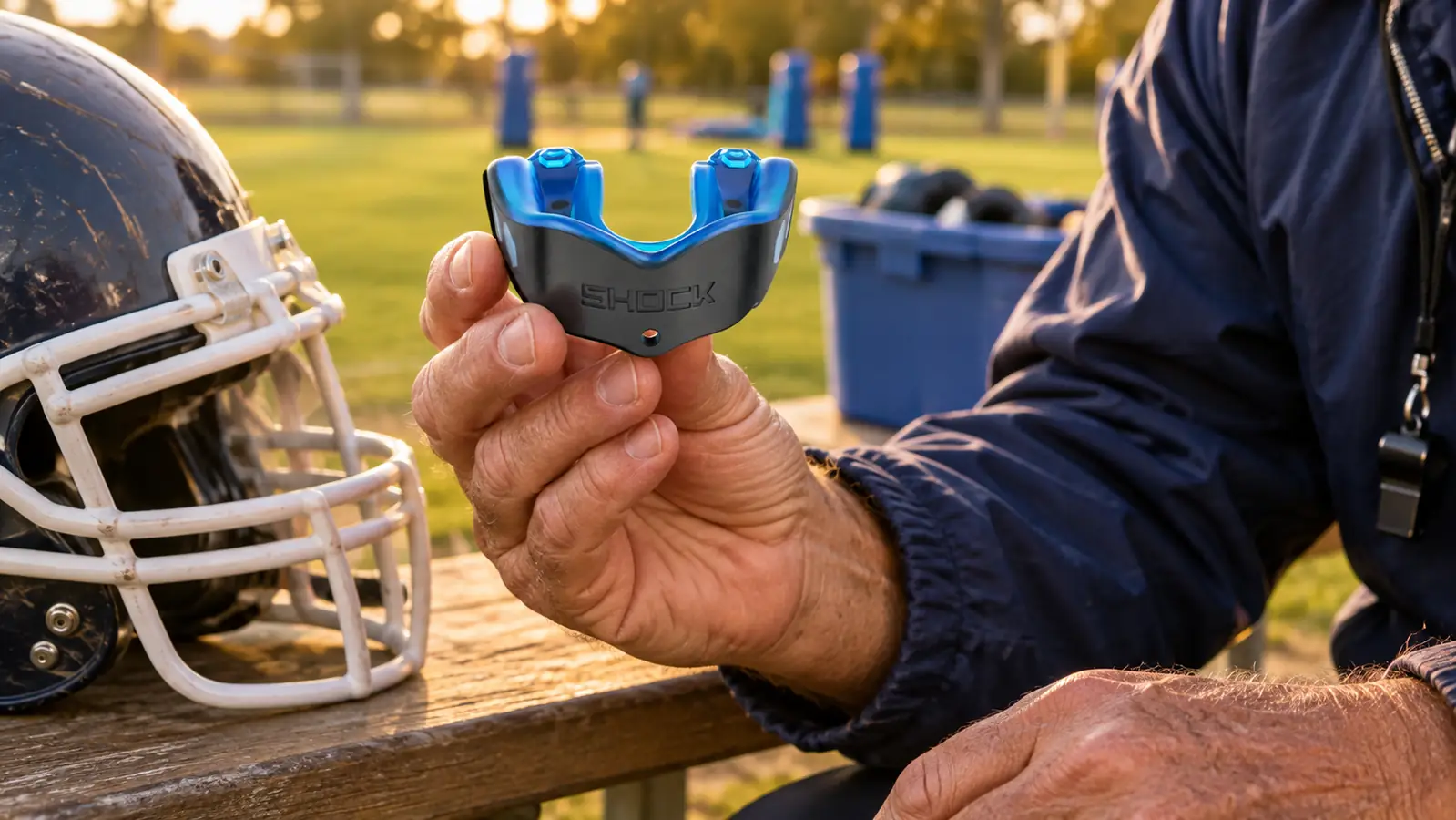
That is the whole argument in one picture. The Shock Doctor Gel Max and a strapped lip guard both protect teeth, both are legal at every level I have coached, and both will make it through a season if your kid takes care of them. What separates them is the four seconds after he takes it out of his mouth.
So here is the short answer before I show you the rest of it. Put the Shock Doctor Gel Max in a lineman or a linebacker. Put a strapped lip guard on the kid who cannot keep track of his own car keys. The Gel Max breathes better and covers more tooth. The strapped guard stays clipped to the helmet, which means it does not end up in a sock at the end of practice.
I coach the JV line in Chattanooga, and I have fitted somewhere north of forty of these guards over three seasons, mostly out of a spare equipment bin I keep in the garage. My checklist is short. Does it stay seated through a pass rush. Can the kid pull air through his mouth when he is gassed. Does it still fit in November, after a hundred practices and one accidental run through the wash. Everything else, the color, the flavor, the packaging, is noise next to those three.
| Shock Doctor Gel Max | Strapped Lip Guard | |
|---|---|---|
| Staying with the helmet | No tether. Out of the mouth means on the turf, in a hand, or wedged in a sock. | The strap clips to the facemask, so the guard hangs from the helmet instead of getting stepped on. |
| Breathing during a long series | Integrated breathing channels are molded through the front of the guard. | Solid front with no channels. You breathe around the guard, not through it. |
| Tooth and gum coverage | One molded piece over the full upper arch and the gum line. | Built around the front teeth and lips, with thinner coverage toward the back. |
| Calling the front in the huddle | Muffled, and it shifts when you talk, so it needs a finger to reseat it. | The tether keeps it from dropping out when you open your mouth wide. |
| Re-seating it with a gloved hand | Takes two fingers and a clean spot on the sideline. | Hangs where you left it, so it goes back in without a search party. |
| Holding up from August to November | One molded piece with nothing mechanical to break. The liner softens before the shell does. | The strap is the wear point. A stretched tether stops clipping tight. |
| Cleaning and care | Rinse, soak, air dry out of the bag. | Rinse, soak, air dry, plus a weekly look at the strap for stretch. |
| Best for | Linemen, linebackers, and any player who wants airflow and full arch coverage. | Skill players who hate bulk, and kids who lose things. |
Where the Shock Doctor Gel Max Wins
The breathing channels are the part I did not expect to care about. Watch a JV line during a four play goal line series and you will see four big kids with their mouths open, sucking wind between snaps. A guard with a solid front makes that worse, so the guard comes out, and a guard that comes out is a guard that gets lost or stepped on. The Gel Max has breathing channels molded through the front, and the kids who switched stopped pulling it out between plays. It is a small thing that turns into a big thing by the fourth quarter of a hot August scrimmage.
I can put a date on it. Second week of camp, 2023, we ran a conditioning set at the end of practice, twelve gassers with about ninety seconds between them. I had six linemen in the Gel Max and four in whatever guard they brought from home. By the eighth rep, three of the four in the solid-front guards had them in their hands, not their mouths. The Gel Max group kept theirs in through the whole set, and one of them, a 240 pound sophomore tackle, told me afterward that he could actually get air through his mouth instead of snorting around the edge of it. That is the entire case for breathing channels, and I did not need a spec sheet to see it.
Coverage is the second win. The Gel Max molds over the full upper arch and the gum line in one piece, with a heavy duty exoskeletal frame sitting behind the Gel-Fit liner. A strapped lip guard is built around the front teeth and the lips, which is exactly where a helmet or a shoulder pad lands, so it is not a weak design. It is a narrower one. The back of the arch takes load too, and a guard covering the whole upper row is doing more work than a guard covering the front four.
Where the Strapped Lip Guard Wins
The strap is not a gimmick. It clips to the facemask, so when your linebacker pulls the guard out to yell a check, it drops against his chin instead of into the grass. I have watched a kid spend an entire drill walking in circles looking for a guard he dropped two minutes earlier, and I have done it with fifteen kids at once. A strapped guard solves a logistics problem rather than a protection problem, and logistics is most of what a volunteer coach actually does between whistles.
Last September I counted it because it had gotten ridiculous. Over two weeks of practice I logged eleven separate stoppages for a lost or dropped mouthguard, and nine of them were players in untethered guards. The other two were a kid whose strap had stretched out and stopped gripping the facemask. I am not going to pretend that is a scientific study, but eleven stoppages in two weeks is eleven drills I had to restart, and a guard that hangs off the helmet would have prevented nine of them.
The other honest win is feel. A strapped lip guard sits lower profile in the mouth, and some players, especially receivers and corners running full speed with their mouths open, find the lighter footprint easier to keep in. That matters more than any spec sheet. A guard your kid actually wears beats a guard with better coverage that lives in his sock, and no amount of comparison shopping changes that.
Built for the player who lines up in the box
Heavy duty exoskeletal frame, Gel-Fit liner, and breathing channels molded through the front. Boils to fit on the kitchen stove. Latex free, listed at 3.54 by 1.81 by 0.39 inches.
Amazon Check Today's Price on Amazon →How the Fit Actually Goes
Boil and bite is simple, and most people still get it wrong. Boil water, drop the guard in for the time on the package, fish it out with a slotted spoon, let it cool until you can hold it, then seat it on the upper teeth and bite down with even pressure. The Gel-Fit liner is the part that softens and takes the mold. The exoskeletal frame is the part that stays stiff and takes the hit.
The mistakes I see most: boiling too long so the liner goes gummy, biting down hard enough that the guard bottoms out against the teeth, and pulling it out to check the fit before it has cooled, which stretches the arch. Fit it at the field house before practice, not in the truck five minutes before kickoff. Do it twice if the first bite comes out crooked, because a guard that sits off center will pop loose every time the kid clenches.
Here is the exact sequence I use now, because I ruined three guards learning it. I bring a pot of water to a rolling boil, kill the heat, and let it sit for thirty seconds before the guard goes in, so it is not hitting water at full rolling agitation. I set a timer for the package time and I do not walk away from it. Then I fish it out with a slotted spoon, lay it on a plate, and wait a full minute before it touches a kid. Count it out loud if you have to. The minute is the step everyone skips and it is the step that keeps the arch from folding over on itself.
One more note, and it matters on our roster because half of Jalen's team is still growing. A kid who fits a guard in August may need a second fitting by October. Boil and bite guards can generally be refit once or twice before the liner gives up, and the Gel Max is no exception. That buys you a second fitting for a boy who put on fifteen pounds and a jaw size between the first game and the fifth.
The flavored variants surprised me. It sounds like a marketing idea until you have smelled the inside of a gear bag in September, and then a guard that does not taste like a locker room starts to look practical. It does not change the protection, so do not pay attention to it if your kid is sensitive to taste. But if the choice is between a guard he avoids and one he tolerates, the flavor is doing real work.
By the eighth rep, three of the four kids in solid-front guards had them in their hands, not their mouths.

What a Full Season Does to Both
By November the Shock Doctor Gel Max looks tired. The liner darkens no matter how well you rinse it, and the front edge goes soft from clenching. None of that means it failed. It means it did its job for three months of practice. I retire a guard when the liner stops holding the mold or when a kid can bite through to the frame, and most JV players get there around the one season mark.
The strapped guard fails differently. The strap is the wear point. It stretches, the clip loses tension against the facemask, and eventually it stops hanging on. A stretched tether is obvious in your hand and invisible on a kid's helmet at thirty yards, so a player can go a week with a guard that is technically clipped on and functionally one hit away from the turf.
Cleaning is a push. Rinse either one in the sink after every practice, soak it once a week in a denture tablet or a mouthguard cleaner, and let it air dry outside the bag. The mistake is leaving it in a closed bag in a hot truck, which is how a guard picks up a smell that follows it for the rest of the season. Do that twice and you will be replacing it in September.
I keep a small log in the equipment bin now, just a clipboard sheet with a name and a date, because after three seasons I got tired of guessing which guard belonged to which kid and when it went in. It takes ten seconds per player in August and it saves a pile of confusion in October, when three boys have outgrown their first fit and nobody remembers who was fitted when. If you run a team bin, even a small one, start the sheet. It also tells you when a guard has quietly gone past its useful life, because the date on the sheet does not care how the liner looks.
What I Liked
- Breathing channels molded through the front, which shows up on long series
- One molded piece over the full upper arch and the gum line
- Boils to fit and can be refit as a kid grows
- Latex free, with no strap or hardware to break
Where It Falls Short
- No tether, so it ends up on the turf if your player spits it out
- The liner darkens and softens over a season
- Needs a careful fitting, not a rushed one before kickoff
- Flavored variants are not for every player
What I Tell Parents at the Fence
Most of the mouthguard questions I get are not really about mouthguards. They are about a kid who keeps taking his out. If that is your kid, the fix is usually fit rather than brand. A guard that was boiled too long, or bitten down too hard, sits loose, and a loose guard is uncomfortable, and an uncomfortable guard comes out at the first whistle. Refit the one you already own before you buy a different one.
If the guard fits and the kid still will not wear it, that is a different conversation and the answer is usually the strap. Some players need the guard attached to the helmet or they will lose it, and losing a guard every other week is its own safety problem, because a kid with an empty mouth is a kid with no protection. Solve the behavior first. Then worry about which guard has the better spec sheet.
Who Should Buy Which
Buy the Shock Doctor Gel Max if your player lines up in the box, wears a helmet with a snug jaw pad, and will keep a guard in his mouth once it fits properly. Linemen, linebackers, fullbacks, and any kid who complains that his current guard makes him feel like he is breathing through a straw. It is also the better pick for a player who is still growing, since you can refit it midseason rather than start over.
Buy a strapped lip guard if your player is a skill guy who cannot stand bulk in his mouth, or if you are the parent of the kid who lost three guards before October. The strap ties the guard to the helmet, and for some kids that is the difference between a guard they wear and a guard they lose. If your player has already lost two this fall, stop arguing about coverage and fix the logistics first.
There is no wrong answer here as long as the guard actually gets worn. I hand out both. The linemen get the Gel Max, the skill kids who cannot keep track of anything get the strap, and the ones who lose both get a talk about their gear bag and a spare in my bin.
The one I hand the linemen first
Full upper arch coverage, breathing channels, and a fit you can redo when the kid grows. Boils in a pot of water on the kitchen stove.
Amazon Check Today's Price on Amazon →