
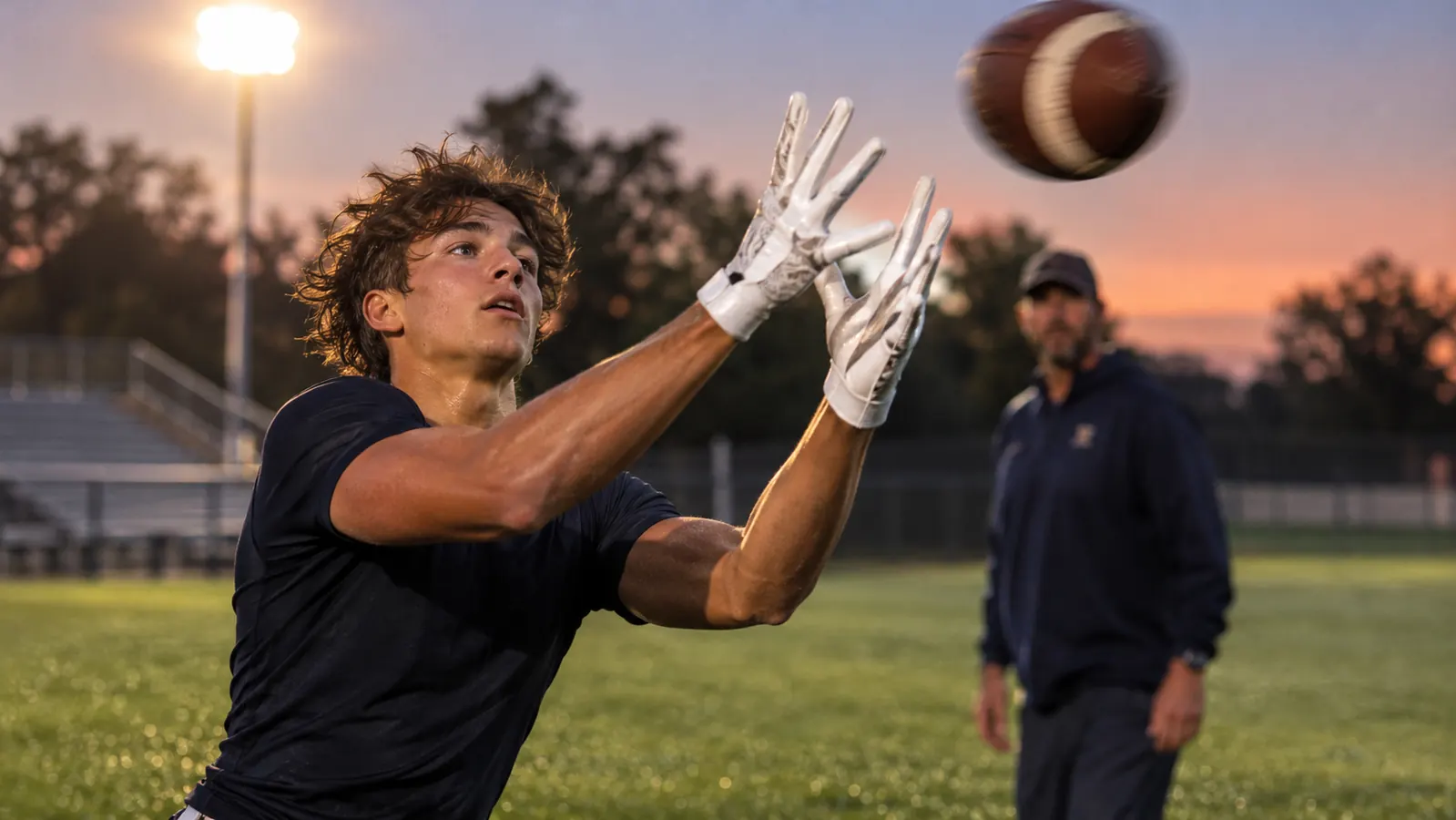
By the second week of October in Chattanooga, Friday night air is wet enough that a football feels like it came out of a cooler. That is the night your receivers find out whether their gloves actually work. I have watched a JV kid in brand new gloves drop three catchable balls in that kind of air, then stand on the sideline squeezing his hands like the gloves belonged to somebody else. He was not a bad receiver. He had a bad palm surface. Grip is not a line on a spec sheet. It is the difference between a first down and a sophomore losing his spot in the rotation.
I am Desmond Pryor. I am 47, I coach the JV line at our high school, and I played offensive line in small college, which means I never caught a pass that mattered until I started running routes with our receivers about six years ago. This season I put our JV receiver group into the Seibertron Pro 3.0 Elite Ultra-Stick football receiver gloves and kept notes from the first practice in August through our last game in November. Not lab numbers. Practice numbers, which are the only numbers that survive a real season in Tennessee. What follows is what held up, what did not, and the one sizing mistake that cost two families a return.
The Quick Verdict
Grip that stays tacky into November, a centimeter sizing chart that actually means something, and a palm that wears out before the seams do. Size it by the chart, wash it every two weeks, and a pair gets a JV receiver through a full season.
Amazon Check Today's Price →The pair that ended the drop complaints by week two
Hook and loop wrist closure, machine washable, and tack that survives a wet Friday night. Measure the palm in centimeters before you order and you will not be sending them back.
Amazon Check Today's Price on Amazon →How I've Used It
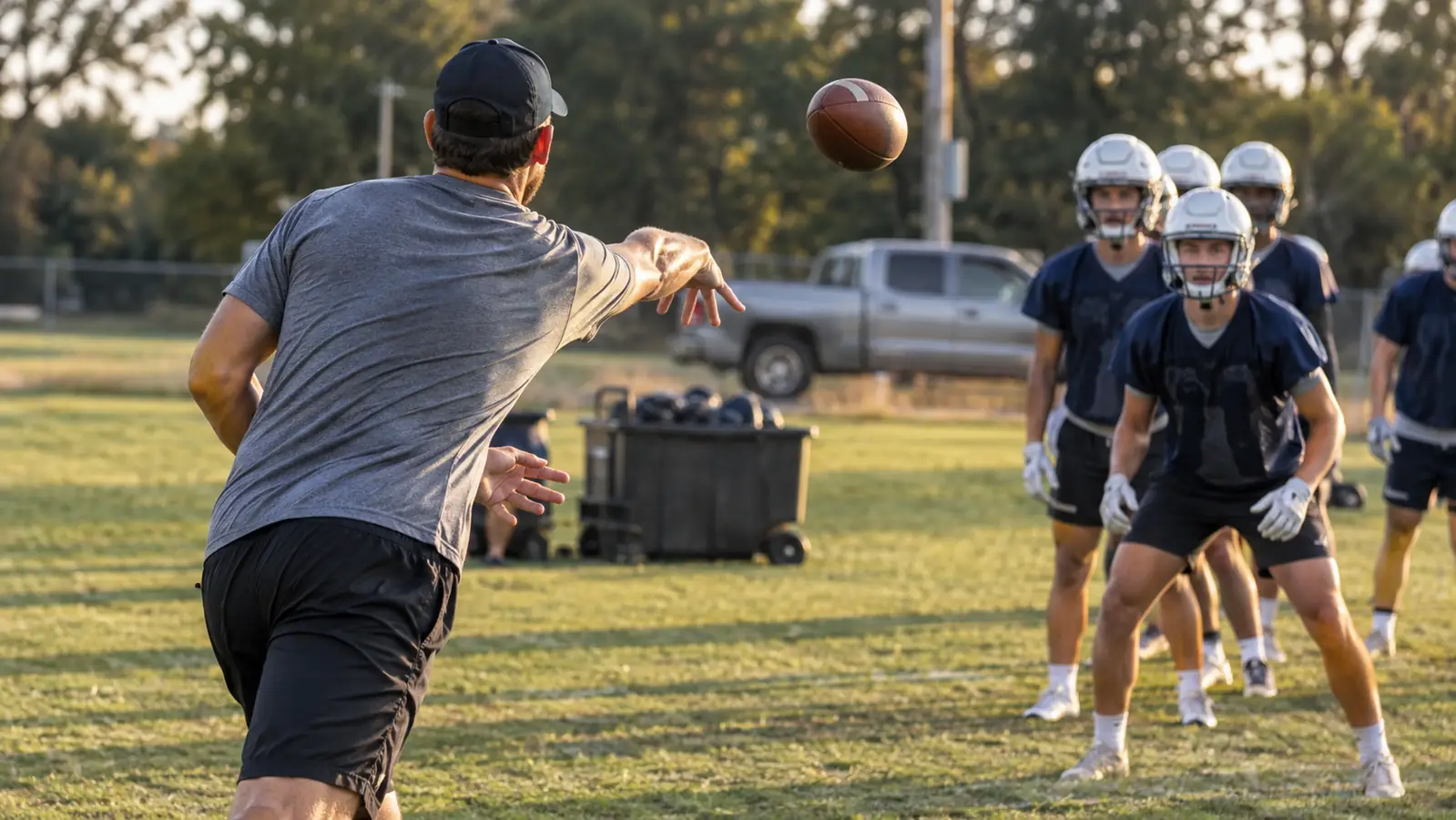
I ran these through 14 practices and 11 games. Mostly I was the arm and not the receiver, so I threw somewhere between 40 and 70 balls a practice at kids wearing them. I also wore a pair myself for one on one reps with our tight ends, which is how a 47 year old with two bad knees ends up learning more about a glove than he planned to. My son Jalen is a sophomore linebacker, so his exposure was interception drills and hands team work. He is hard on gear and blunt about it, which makes him the most useful tester on the roster.
The first practice is worth describing because it is where most gloves lose me. A new receiver glove is usually stiff in the fingers, and the kid spends two weeks catching with his palms flat like he is fielding a ground ball. The Seibertron pair was flexible straight out of the package, flexible enough that our quarterback noticed and asked whether they had already been broken in. They had not. They went from the shipping box to the field in about an hour and the tack was live on the first rep. That is unusual at this level, and it is the reason I did not spend September rotating pairs between receivers.
What I tracked was narrow on purpose. First contact grip, meaning does the ball stick on the first squeeze without the kid trapping it against his chest. Fit at the wrist, because a loose cuff on a receiver glove becomes a fumble in traffic. Wear, checked every Sunday when I dumped the equipment bin on the garage floor. And how they felt after a wash, which is the part most reviews skip because most reviewers never put a glove in a machine. I had eight pairs in circulation and I checked every one of them every week.
For comparison I kept three other things in the bin: a stack of school issued gloves from previous seasons, a donated pair of Nike Vapor Jets a parent dropped off, and a cheap pair a freshman bought at a gas station on the way to a scrimmage. That last one is not a joke. It lasted one practice and then lived in the bin as a warning to the others.
Grip: What Ultra-Stick Means When the Ball Is Wet
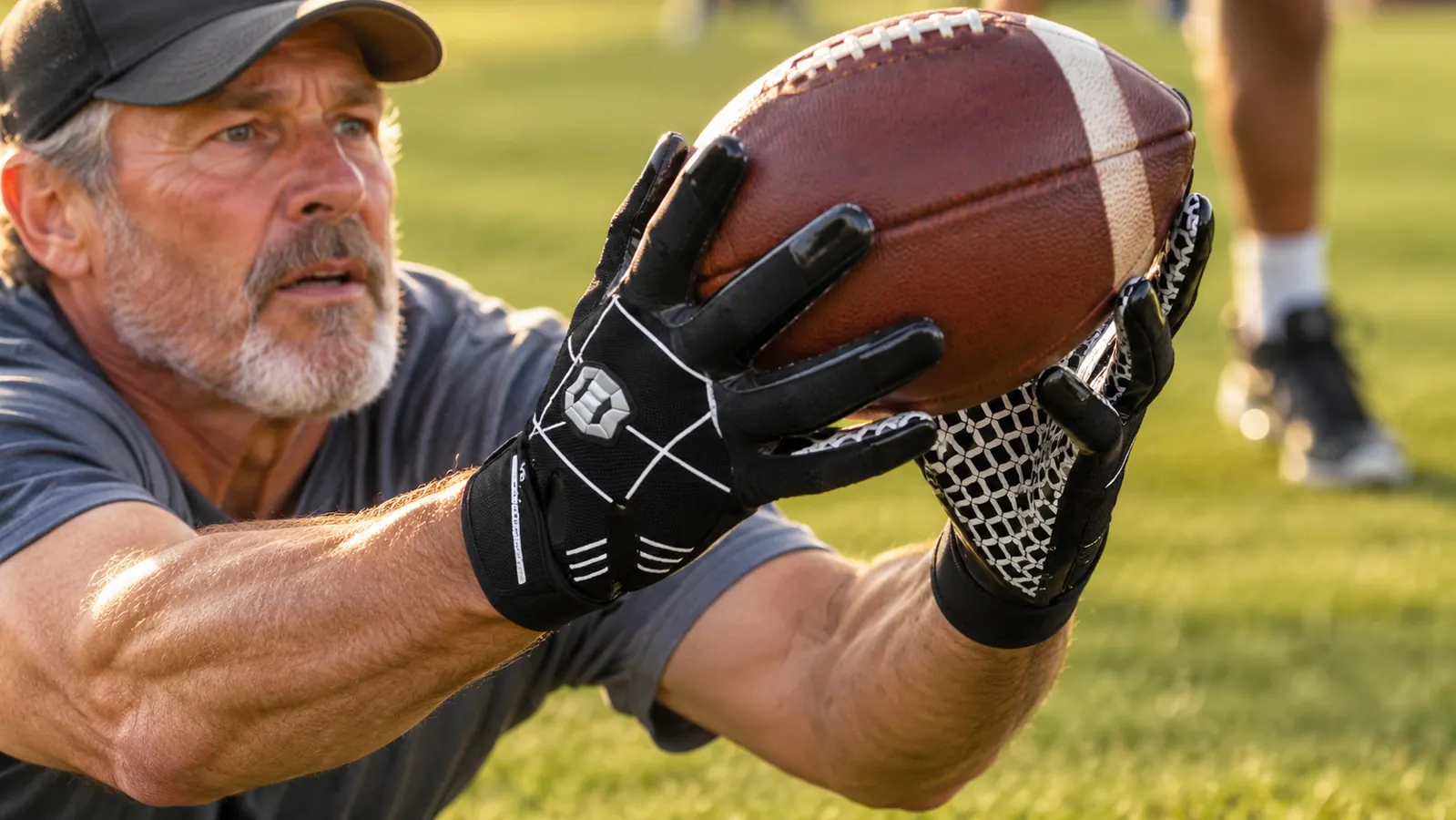
The name on the box is Ultra-Stick, and names on boxes are usually marketing. So here is the field version. Our first practice in August was 94 degrees and dry, and the ball was easy for everybody. The real test came on a Thursday in late September when a front moved through and the field went from dusty to slick in about 20 minutes. Balls were hitting kids in the hands and bouncing off into the grass. The pairs that kept catching were the Seibertron pairs and the donated Vapor Jets. The school bin gloves were done by the second drill.
Where the Seibertron pulled ahead was on balls thrown behind the receiver. Good tack on the palm catches what is in front of you. Tack that reaches the fingers catches the ball you have to reach back for. We ran a drill where I deliberately underthrew crossing routes to force a back hand catch, and the kids in the Seibertron gloves came down with roughly seven out of ten. That is not a scientific number and I am not going to pretend it is. It is the number that made me stop rotating gloves between receivers.
Our quarterback is not a gear guy. He is a 16 year old who throws 40 balls a day and notices when a receiver makes him look good. Around week four he told me the Seibertron kids were catching balls the other kids were dropping, and asked me to order him a pair even though he does not catch passes. I did not order him a pair. I did write it down, because a quarterback volunteers that kind of opinion about once a season.
Cold matters too. Our last two games were in the 40s and those gloves had been washed four or five times by then. Grip was down from August but still better than a dry, unwashed pair of anything else in the bin. What kills tack faster than cold is dirt. A glove that catches 50 balls on a dusty field and never gets washed turns slick by halftime, and the kid blames the glove when the glove is just full of infield grit.
Eleven games, a few thousand catches across eight pairs, and the two that failed failed at the seam where the thumb meets the palm, not in the palm itself.
Fit and the Sizing Chart Nobody Reads
Seibertron's listing says something most gear companies will not: centimeter data has less deviation than inch data. Believe them. Measure palm length and palm circumference in centimeters, then match those two numbers to the chart instead of guessing from the youth or adult label. The chart puts Youth XS at 13.4 to 14.2 centimeters palm length, Youth M at 14.7 to 15.5 centimeters, and Youth XL at 16.3 to 17.3 centimeters, with the adult sizes continuing above that. Two numbers, one chart, no guessing and no returns.
Half our JV roster sits between a youth large and an adult small, and every one of those kids wants to wear a medium because it sounds tougher. A receiver glove that is one size too big slides at the wrist and rotates on contact, and the kid drops a ball he should have caught. We sized 11 players off the centimeter chart and had two returns. Both were kids who measured right on the line between sizes and went the wrong direction. Two out of eleven is a good hit rate for a chart that most people ignore.
The gloves are ambidextrous, which sounds like a small thing until you are handing out gear in a locker room. There is no left and no right to sort. A kid can put a glove on either hand and the hook and loop closure across the back of the wrist takes up the slack. That strap does collect turf and dust, and it needs a shake and a wipe before it will hold cleanly again, but it never slipped during a rep and I never had a kid ask me to tighten one mid practice.
One caution on the adult medium, which is the size I wore. It is an adult glove with adult proportions, and it is not going to fit a big 13 year old just because he is tall for his grade. That kid needs to be measured, not flattered by a label. The material is synthetic and it does not stretch much over a season, so the fit you get in week one is close to the fit you get in week ten.
Durability Across a Full Season
We bought eight pairs in August. By the last game, two had failed at the seam between the thumb and the palm, four were worn thin in the middle of the palm but still catching, and two were still in good shape. The two failures belonged to our two busiest receivers, kids who take 60 to 80 reps a day in practice. That is a hard workload for any glove in this category, and I would not call the failure a defect. I would call it normal wear with an honest timeline attached to it.
The wear pattern is worth knowing before you buy. The palm goes before the fingers, and it goes in the middle where the ball actually lands. On a school issued glove you usually see a seam let go first, which is worse, because it happens in the middle of a practice and there is no fix for it. On the Seibertron the palm thins gradually and you get a week or two of warning. If your kid catches 40 balls a day, plan on a new pair around week eight. If he practices three times and plays once, a pair should carry you to the last game.
The two pairs that survived cleanly were both washed every other week. That is not a coincidence. Dirt is abrasive and it grinds the palm surface down faster than contact with the ball does. If you take one thing from this review, take the wash schedule, because it added roughly a month of usable life to the pairs we tracked.
What I Liked
- Tack is live on the first rep, no break-in period needed
- Still catching in wet, cold November conditions after multiple washes
- Ambidextrous, so handing out team gear takes seconds
- Centimeter sizing chart is accurate enough to cut returns
- Machine washable, which is rare and matters for a team buy
Where It Falls Short
- Palm thins out around week eight for high-volume receivers
- Two of eight pairs failed at the thumb seam over a full season
- Hook and loop strap picks up turf and needs regular cleaning
- Runs true to measurement, so guessing a size will burn you
Washing Them Without Wrecking Them
The care instructions say machine wash, and that is the reason I keep buying this line for a team rather than for one kid. I run eight pairs through a cold cycle with no detergent softener and no dryer, then they air dry on the lid of the equipment bin in the garage. They come out tacky again. Not new glove tacky, but close enough that nobody complains. What I would not do is wash them the night before a game. They need a full day to dry, and a damp glove is worse than a dirty one.
My schedule is every two weeks in season, plus any practice on a wet field. Eight pairs, one cycle, done in an hour. That routine is the difference between a glove that lasts eight weeks and one that lasts four, and it costs nothing but a load of laundry. Air dry only. A dryer will cook the palm, and you will know it the moment the kid tries to catch a ball.
Who This Is For
This is for the parent of a youth or high school receiver who is tired of buying gloves that go slick by week three. It is for the adult rec player who suits up on Sunday mornings and does not want to think about gear again until next fall. It is for the coach who buys for a group and needs a chart he can apply in a locker room with a tape measure and two minutes. It is also a reasonable first real glove for a kid moving up from a general athletic glove, because tack helps a young receiver learn to catch with his hands instead of his chest.
Who Should Skip It
Skip it if your kid is a lineman who never catches anything. A receiver glove on a lineman is a waste of a good palm and it will be destroyed in a week of hand fighting. Skip it if you are not going to measure. Order one size off the chart and you will decide the glove is bad when the fit is bad. Skip it if you expect one pair to survive a 70 rep a day season, because nothing in this category does. And skip it if your kid refuses to wash anything, because an unwashed glove is a four week glove no matter what the box says.
Measure the palm, order the pair, stop thinking about gloves until November
Centimeter sizing chart, hook and loop wrist closure, machine washable. Everything a JV receiver needs and nothing he will lose in the bottom of the equipment bin.
Amazon Check Today's Price on Amazon →