
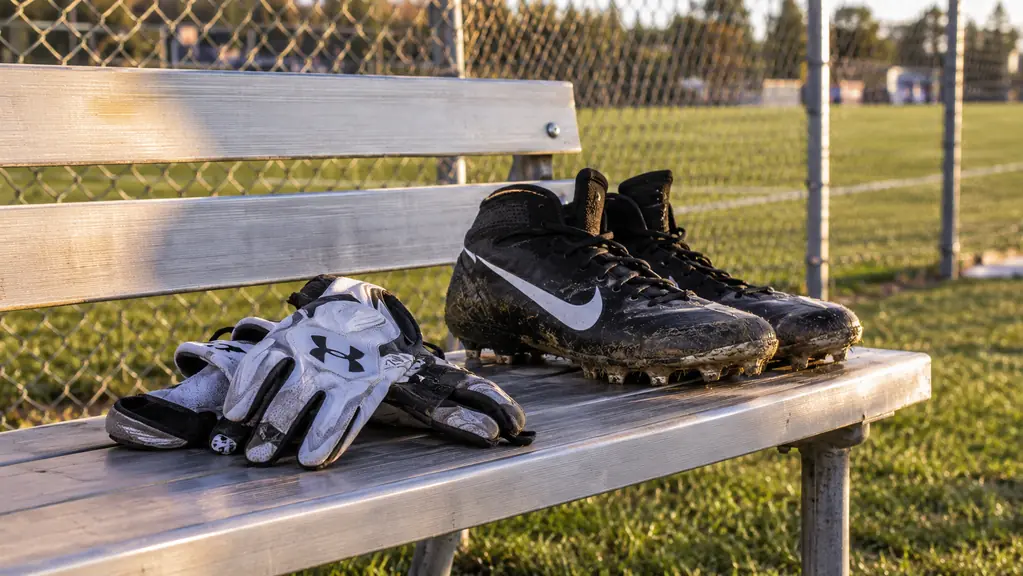
The first pair of gloves Jalen brought home from a fall practice came out of the back of my gray pickup looking like it had been used to change a tire. Gray with field grit, fingers curled into a permanent claw, and the palm surface that had been so sticky in August now felt like an old mouse pad. He told me the grip was gone. I told him we were not buying a new pair in week three of the season. That argument is the reason I started paying attention to how we wash and store gloves instead of throwing them in the equipment bin and hoping for the best.
Here is what a season of trial and error taught me, plus one ruined pair I would rather not talk about. The Seibertron Pro 3.0 Elite Ultra-Stick is a solid receiver glove, and it will stay tacky for months if you treat it like equipment instead of a towel. It will also be dead in three weeks if it lives in a hot truck or goes through a dryer. The glove is not the variable here. The care is. This is the routine we run in my garage now, and it is the one I hand to the parents on our JV sideline every August.
The glove that rewards a five minute wash
The Seibertron Pro 3.0 Elite Ultra-Stick holds its tack through a season of practices when you clean it right. Measure the palm against the size chart before you order, because fit is half the battle.
Amazon Check Today's Price on Amazon →Step 1: Know what you are washing before you get it wet
The Pro 3.0 is a synthetic palm glove with a hook and loop closure at the wrist, and the care instruction on the listing says machine wash. I believe that listing. I also think machine wash is the ceiling of what you can get away with, not the target you should aim for. A tacky palm is a thin coating on a synthetic surface, and hot water, harsh detergent and mechanical agitation all attack that coating. Every step below has the same goal: remove dirt and salt without stripping the film that makes the glove grip.
Start with size, because size is maintenance. A glove that is too tight splits at the seams when a player pulls it on with wet hands, and a glove that is too loose rotates around the hand and forces the player to grab at the ball instead of catching it. Seibertron publishes palm length and palm circumference in centimeters, and the listing notes that centimeter data has less deviation than inch data. Measure the hand, write the number down, compare it to the chart, and order that size. A glove that fits does not get stressed every time it goes on, and that alone adds weeks to its life.
Before any water touches the glove, close the hook and loop tab at the wrist. An open tab will grab the palm material in the wash and tear at it, and it will collect every piece of lint in the laundry room. Close it, then pick the lint out of the hooks with a toothpick once a month. The closure is the first part of a glove to stop holding, and it is almost always lint rather than wear.
Step 2: Wash by hand in cool water with mild soap
Fill a sink or a plastic tub with cool water and one small drop of mild liquid soap. Not dish detergent with a degreaser in it, not a laundry pod, and nothing with bleach or fabric softener. Fabric softener is the worst thing you can bring near a tacky palm, because it works by leaving a slick film on fibers, and a slick film is the exact opposite of what makes a glove catch a football. Swish the water once with your hand to mix it and stop.
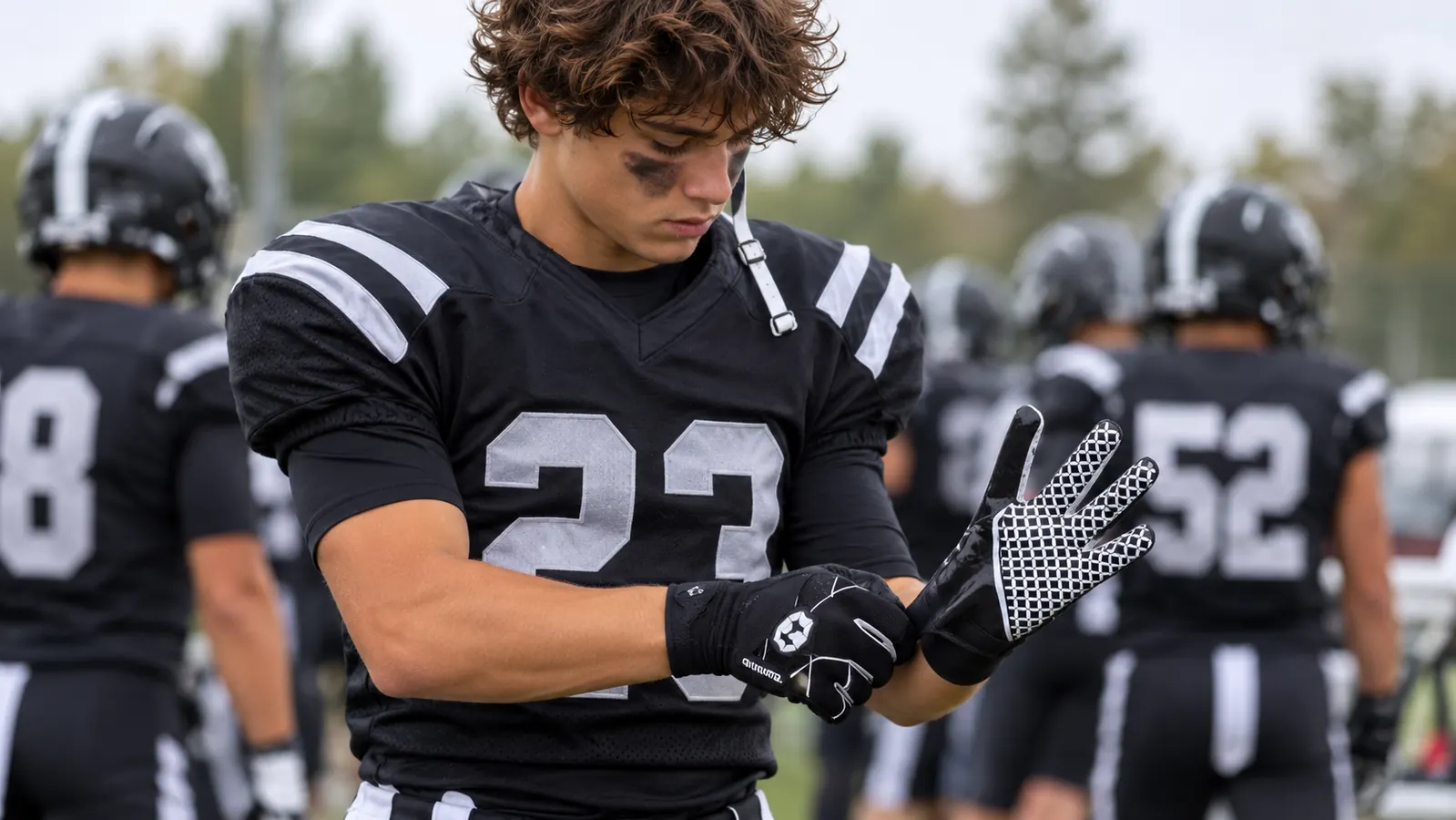
Put the gloves on and wash them the way you wash your hands. This is the part that matters most and the part most people skip. Wearing the gloves lets you work soap into the palm and between the fingers with the glove in its natural shape, so you are not stretching a wet glove out of shape by scrubbing it flat against a washboard or the bottom of a sink. Work the palm, the fingers, the thumb, and the webbing between the thumb and index finger, which is where field dirt packs in and stays. Two minutes of this is plenty. Five minutes does not make it cleaner, it just gives the water more time to work on the coating.
If the gloves are heavily soiled, and by October they will be, bring in a soft toothbrush for the palm only. Light circles, no pressure, no scrubbing hard enough to abrade the surface. Leave the back of the hand alone. That side is usually a stretch material that does not need brushing and will pill if you try.
How often should you wash them? For a high school player practicing four or five days a week, once a week during the season is about right, and more often if the field is wet. Washing after every single practice is overkill and shortens the life of the coating. Washing once a month is not enough, because dirt and salt work into the palm and dry it out from the inside. Once a week, on a Sunday, in the sink, with a fan on the counter afterward. That is the whole schedule.
Step 3: Rinse cold, squeeze, and never wring
Rinse under cool running water until the water runs clear and stops feeling slippery under your thumb. Soap residue is a grip killer, so rinse about twice as long as feels necessary. Then squeeze the water out from the wrist toward the fingertips, one finger at a time, the way you squeeze toothpaste out of a tube. What you do not do is wring the glove like a washcloth. Wringing twists the palm and puts a crease in the coating that does not come out, and that crease is where the glove starts to fail.
Blot the worst of the water with a clean towel. Press, do not rub. Fold the towel over the glove, put a hand on it, and let the towel do the work. Then move to drying, which is where most gloves actually get ruined.
Fabric softener works by leaving a slick film on fibers. A slick film is the exact opposite of what makes a glove catch a football.
Step 4: Air dry it away from every source of heat
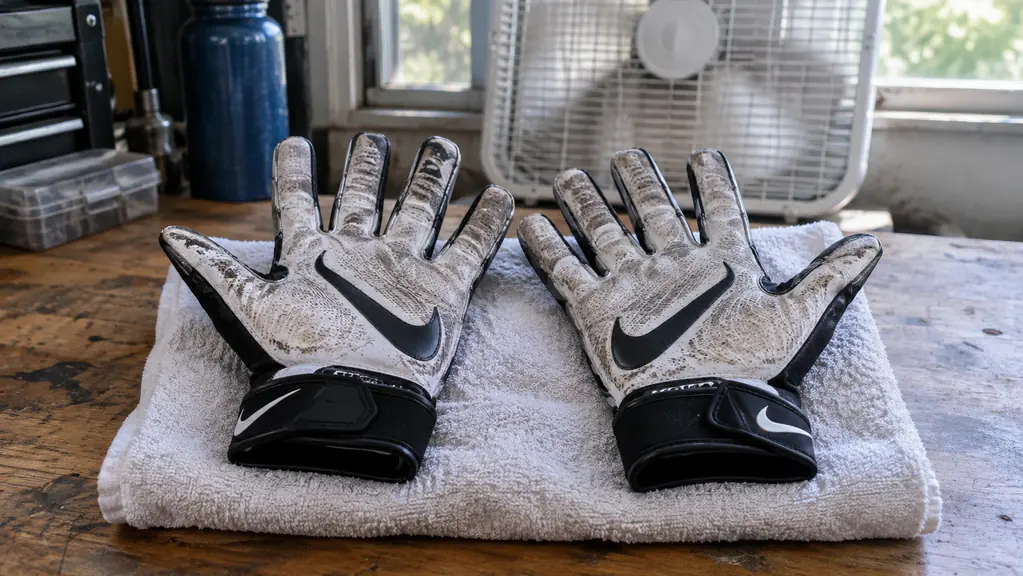
Lay the gloves palm up on a clean towel on a counter or a workbench, fingers spread, out of direct sun and away from anything that produces heat. Not the dryer. Not a radiator. Not the dashboard of the truck. Not the space heater in the garage. Heat is what turns a tacky palm into a stiff, slick one, and it does it in about twenty minutes. I lost a pair to a truck dashboard one June afternoon and I have not made that mistake twice.
Moving air works better than warm air. A box fan on low in the same room will cut the dry time in half with no risk at all. Flip the gloves once at the halfway point, usually after an hour or two, so the back of the hand dries too. Do not put a glove on until it is completely dry inside. A damp glove stretches when it goes on and stays stretched, and a stretched glove fits like a glove one size too big.
If the game is in two hours and the gloves are still wet, the fan is still the answer. There is no safe shortcut and I have tried most of them. A glove dried on a radiator comes out with a palm like a potato chip, and there is no bringing it back.
Step 5: Store them like equipment, not like laundry
Once the gloves are dry, close the hook and loop tab and put them somewhere they will not be crushed. A mesh bag, a shoe box, a drawer in the garage cabinet, any of those work. What they should not go into is the team equipment bin, which by midseason is a pile of shoulder pads, cones, water bottles, and whatever got thrown in on a Friday night. Weight on a glove flattens the palm and creases the fingers, and a creased finger is a finger that will not close on the ball.
The other thing that kills gloves is a hot vehicle. If your player leaves the gloves in a gym bag in the back seat from August through October, the heat cycles alone will take the tack down, and no amount of washing brings it back. We hang the bag on a hook by the garage door now. It took one season to build the habit and it has been worth it.
Between washes, wipe the palm with a damp rag after a practice in the rain or on a wet field. Mud left on the palm overnight pulls moisture into the coating and dries it out. Thirty seconds with a rag saves you a full wash, and every wash you skip is a little more life left in the glove.
What Else Helps
Two pairs in rotation beat one pair washed twice as often. Tacky palms wear out from contact, not from washing, and giving a glove a full day to dry between uses extends the life of both pairs. A lot of high school players carry a practice pair and a game pair for exactly this reason. That is not a luxury, it is maintenance on a schedule, and it is the single cheapest change a family can make.
Keep fingernails trimmed. Nothing shreds a synthetic palm faster than a thumbnail digging into the seam every single time the glove goes on. Teach your player to take gloves off by the wrist tab and not by the fingers, because pulling by the fingers stretches the finger stalls and leaves the glove loose at the tips.
If your player likes glove tack or chalk, it goes on a clean, dry palm. Putting tack on top of field grit just glues the grit in place, and then you are washing the glove with an extra layer of stuff to remove.
And be honest about when a glove is done. Once the palm is shiny and slick even after a wash and a full dry, the coating is gone and no routine brings it back. The Seibertron Pro 3.0 holds up well for a synthetic palm glove and it has a deep pile of reviews behind it, but it is still a wear item. Buy the size the chart says, wash it the way this article describes, rotate it, and you will get a full season out of a pair. Skip all of that and you will be buying gloves in October like everybody else.
Get the pair that can survive this routine
If your player is starting the season with gloves that are already slick, care advice will not save them. The Seibertron Pro 3.0 Elite Ultra-Stick is the pair we keep in our rotation. Measure the palm, order what the chart says, and wash it the way this article lays out.
Amazon Check Today's Price on Amazon →