
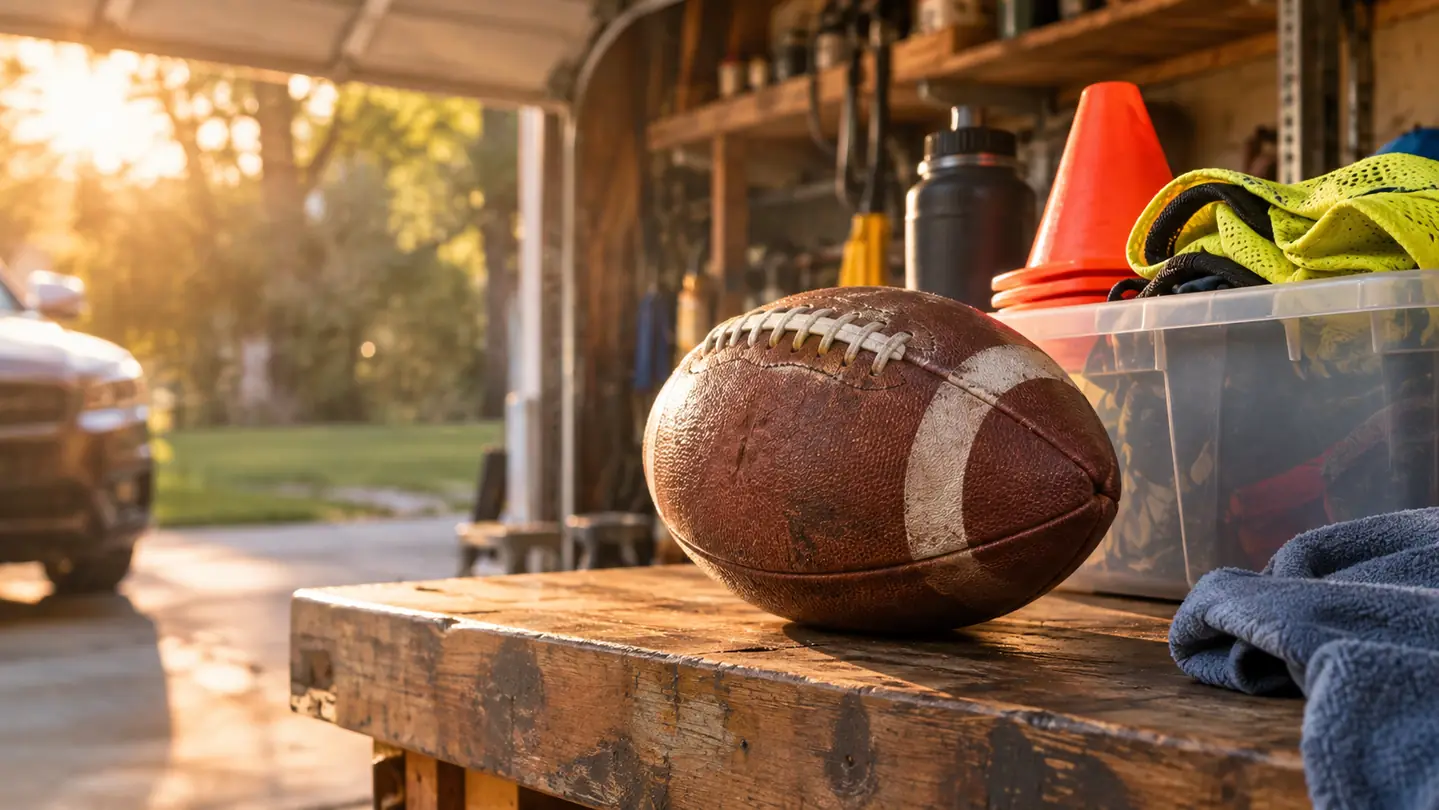
Every August I open the equipment bin in my garage and count footballs. Every August the number is smaller than I remember, and half of what is left feels like a bag of sand somebody left out in the sun. I coach the JV line at the high school here in Chattanooga, and I have a sophomore linebacker at home who wants to throw on Tuesday nights whether I am ready or not. Between the two, we go through footballs faster than any other piece of gear we own.
The one that keeps ending up in my hand is the Wilson NFL Super Grip Composite Football. Not because it is fancy. Because it is the ball that is still firm, still grippy, and still holding air in February when everything else in the bin has gone soft. Here are ten reasons it earns the spot, written for the parents who are about to buy their kid a ball this week.
The ball that survives the bin, not the one that starts in it
Composite cover, stitched construction, official size for high school and college players ages fourteen and up. This is the one my son grabs first.
Amazon See the Wilson NFL Super Grip on Amazon →It survives the equipment bin
My bin is a plastic tub that rides in the back of a gray pickup, sits in a garage that hits ninety degrees in July, and gets rained on more than I want to admit. Cheap balls come out of that tub feeling like a beanbag by week three. The Super Grip has a stitched composite cover, and it has taken three seasons of that treatment without the cover separating or the seams going soft. That is most of the review, honestly. It holds up to the way families actually store things.

The composite cover keeps its grip when your hands are cold
October practices in Tennessee start around fifty degrees and end colder than that. Leather balls get slick in that air. Composite holds better. Wilson built this cover for the balance between softness and toughness, and you can feel that the first time you wrap a hand around it. My son throws after school when the light is going, and he has not once come inside complaining the ball felt like a bar of soap. For a line coach, that is the only field test that matters.
Official size means the reps transfer to Friday night
The official size ball is listed at 11.36 inches, and it is the size a high school player actually plays with. If the ball in your backyard is smaller than the one in the game, every rep your kid takes is a rep with a different release and a different catch radius. He gets good at catching a ball nobody throws on Friday. Buy the size he plays and let the backyard match the field. The adjustment time in August is where you notice the difference.
The classic laces teach real throwing mechanics
A lot of practice balls have laces that are printed on or molded flat. This one carries the classic style laces you find on a game ball, and that matters more than parents expect. Young quarterbacks find their grip on the laces. Receivers use them to track the ball in the air. When the laces are right, the throwing motion comes out right. When they are molded flat, kids learn a grip they have to unlearn in August, and unlearning takes longer than learning did.
The butyl rubber bladder holds air between practices
Every ball in my garage has lost air at some point. The ones with a butyl rubber bladder inside tend to keep it longer, and this one is built that way. I check the Super Grip maybe once a month, and most months it does not need the pump. That sounds like a small thing until you are standing in the driveway at 6:40 on a Tuesday evening with a ball that feels like a deflated inner tube and a kid already in his stance waiting on you.

It ends the one good ball problem
Every family has one good ball and four bad ones, and nobody can find the good one when it counts. Buy a ball that is worth keeping and the search stops. This one throws the same in September and in November. Same weight, same cover, same release off the hand. Consistency is what turns backyard time into real practice, and it is the thing a cheap ball can never give you no matter how many of them you buy.
It carries a full individual period on its own
I run individual periods with nothing but a ball and a set of cones. Ball security drills, snap work, footwork with the ball tucked in the arm. The composite cover has enough texture that a kid can work high and tight without the ball sliding out on every rep. You do not need a partner, a net or a machine to get better. You need a ball that behaves the same way every time he squeezes it, and that is the whole point of the drill.
The size chart actually tells you what to buy
Wilson lists the official size for high school and college players, ages fourteen and up. The junior size is built for fourth through sixth grade, ages nine to twelve. That is more guidance than most listings give you, and it saves you the guessing game at checkout. If you have a sophomore at home, you want the official size. If you have a fourth grader, buy the junior and do not hand him a ball he cannot grip or throw.
It feels like a game ball in the hand
At 454 grams, the Super Grip sits in the same weight class as the ball your kid sees under the lights. Soft composite cover, stitched construction, real laces. Nothing about it feels like a toy or a promotional giveaway somebody handed out at a car dealership. When a player picks up a ball that feels right, he throws it with confidence. Confidence is not a small thing in a fifteen-year-old who is still figuring out what his arm can do.
It is one purchase instead of three
I have bought the cheap ball. I have bought it twice in one season, which is the part nobody warns you about. One ball that holds its cover, holds its air and holds its shape costs you less trouble in the end than replacing the disposable version every six weeks. That is the whole argument for buying the Wilson in the first place. Not because it is fancy, but because you buy it once and then you stop thinking about it until next August.
What I'd Skip
Skip the youth-size ball for a teenager, even when it is the only one on the shelf. Skip the promotional ball with a logo stamped onto a glued-on cover, because those laces are decoration and the cover will peel by October. Skip buying a set of five before you know whether your kid will actually use them. And skip the idea that a practice ball should be a beater you do not care about. One good ball in the garage does more for a player than a bin full of bad ones, and it costs you far less attention over a season.
It holds up to the way families actually store things: a hot garage, a truck bed, and a kid who leaves it out in the rain.
Where This One Fits
If your house has a player fourteen or older, this is the ball. High school and college players are the group Wilson builds the official size for, and the composite cover is the reason it survives a Tennessee fall. If your player is in fourth through sixth grade, get the junior size and let him grow into this one. Either way, keep it in the garage with the rest of the gear instead of the trunk of the car, and check the air once a month. That is the entire care routine.
One ball, one season, no excuses
Official size for ages fourteen and up, stitched composite cover, butyl rubber bladder. The ball that is still in the bin in February.
Amazon See the Wilson NFL Super Grip on Amazon →