
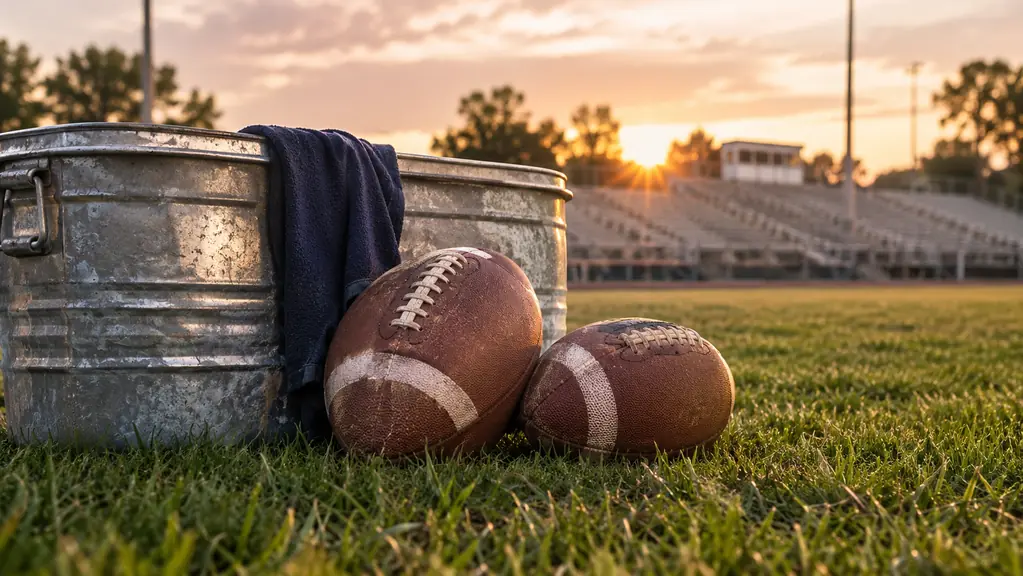
Every August the same email lands in my inbox from a parent who just left a sporting goods store: composite or leather? I coach the JV line at a high school here in Chattanooga and I keep the team's spare equipment bin in my garage, hauling it to practice in the back of a gray pickup. That bin currently holds a Wilson Super Grip Composite in official size and a leather game ball that costs a good deal more. My son Jalen is a sophomore linebacker, so both balls have been thrown, kicked, dropped and left out in the rain by a 15-year-old who was not thinking about cover material at the time. I have also handed both of them to ninth graders at practice, which is a faster and more honest test than anything I could run on my own.
Here is the short answer, and then I will show my work. For most families, buy the Wilson Super Grip first. It is stitched, it has a composite cover over a butyl rubber bladder, it comes in an official size and a junior size, and it is catchable on the first throw instead of the fiftieth. The leather game ball is the better football. It is also the wrong first purchase for a household that just wants a kid getting reps in the backyard after dinner.
| Wilson Super Grip Composite | Leather Game Ball | |
|---|---|---|
| Feel out of the box | Soft composite, catchable on the first throw | Stiff and slick until it is broken in |
| Feel at its best | Consistent, does not change much with use | Tacky and dense, the way a game ball should feel |
| Cover and bladder | Composite cover over a butyl rubber bladder | Leather panels over a bladder |
| Wet weather | Wipe it on a shirt and the grip comes back | Soaks up water, gets heavy and slick |
| Break-in | None worth mentioning | Weeks of throwing before it feels right |
| Seams and laces | Stitched, raised seams, classic laces | Stitched, laces flatten down once worn in |
| Sizes | Official size at 11.36 inches, plus a junior size for ages 9 to 12 | Usually official size; junior leather is harder to find |
| Kicking | Fine for practice, a bit flat off the tee | Truer flight off the foot |
| Game day | Practice ball, not a game ball | What the varsity quarterbacks throw on Friday |
| Care required | Almost none | Must be dried and stored indoors |
| Season wear | Holds up, cover picks up a shine with heavy use | Improves with age if it is looked after |
Where the Wilson Super Grip Wins
The composite cover is the entire argument. Wilson builds this ball to sit in the middle between softness and toughness, and that middle is exactly where a practice ball should live. A new leather ball is a stiff, slick object that punishes fingertips, and I have watched ninth graders fight one for two weeks before they trusted their hands. The Super Grip does not have that problem. It shows up soft enough to catch and it stays that way through a season of two-a-days, and the classic laces give a young quarterback a place to put his fingers without hunting for them.
The construction is honest, too. Stitched seams, a butyl rubber bladder, official size at 11.36 inches in diameter and 454 grams on the scale. That is a real football in the hand, not a foam toy that floats. The junior size covers grades four through six, ages nine to twelve, and that matters more than most parents realize. A 10-year-old throwing an official size ball develops a hitch in his motion that a coach will spend a whole season undoing. Wilson sells both sizes in the same line, so a younger brother can throw a ball that fits his hand while the older one throws the same model in official size.
And then there is a Tennessee August. Dew on the practice field at seven in the morning is not a light mist. Composite does not drink water the way leather does. Wipe it on your shirt and the grip comes back, and the ball does not gain weight overnight. I have pulled this one out of wet grass, out of a puddle that formed in the garage, and once out of the truck bed after a storm, and it has never gone slick or heavy on me. The bladder has held air since the day it arrived. That sounds like a low bar until you have pumped up four other footballs in a single season.
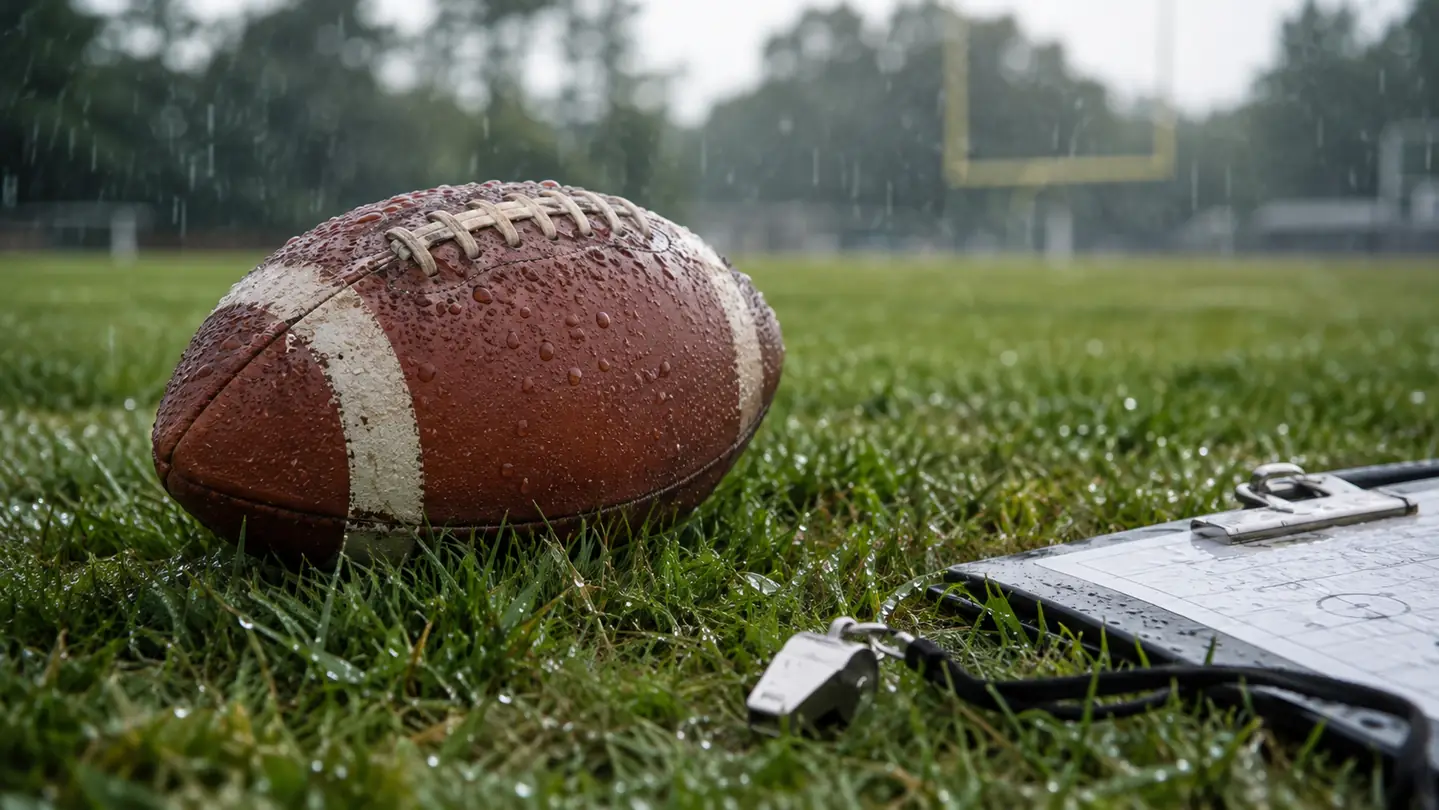
The clearest test came on a Thursday in September, a downpour that hit about twenty minutes into practice and sent everybody under the shed behind the bleachers. I left the Wilson out on purpose, sitting in wet grass, and walked back to it roughly forty minutes later expecting the worst. I shook it off, wiped it across my shorts, and threw a ten yard out to a sophomore who caught it without a single comment about the ball. That is the entire test, and the leather ball failed the same one the same afternoon. It came up heavy in my hand and slick enough that I stopped throwing it rather than teach a kid to fight his equipment.

Where the Leather Game Ball Wins
Now the other side, because leather wins things and pretending otherwise would make me a bad witness. Once it is broken in, nothing feels like it. Leather takes on a tack that composite cannot copy, a slightly sticky surface that grabs the fingertips on the release. A quarterback who has spent a fall with a properly broken-in leather ball will tell you the composite feels like a pillow. He is not entirely wrong. If your kid is the varsity quarterback or the kicker, the ball he throws on Friday night is leather, and practicing all week with something else is practicing a different sport.
The leather ball also lasts in a way the composite ball simply does not. Broken in properly and stored dry, it keeps improving for years. The composite ball holds up fine, but it does not improve. It stays what it was on day one, which is a good practice ball and not a game ball. There is a lesson in that for a teenager, too. A kid who learns to dry a leather ball, keep it out of the truck bed overnight and wipe it down once a month has learned something that carries over to cleats, to helmets, to anything else he owns that costs money.
Start with the ball a kid can catch on day one
The Wilson Super Grip in official size or junior size. Stitched composite cover, butyl bladder, and no month of break-in before practice starts.
Amazon Check Today's Price on Amazon →What the First Month Looks Like
The first month is where these two balls separate for a family, so here is the timeline. Week one with the Wilson is week one with a football. You take it out of the box, you check the air, you throw it. A 12-year-old catches it cleanly by the second or third rep. Nothing about the ball asks anything of him. That is not a small thing when the alternative is a child who decides in September that he is just bad at catching.
I have watched that happen, and it sticks with me. A freshman who could not hang onto a stiff leather ball in August spent the rest of that fall calling himself a kid who could not catch. He was not wrong about the ball. He was wrong about himself. The Wilson would have told him a different story in week one, and I have wondered since whether that one purchase would have changed the whole season for him.
Week one with the leather ball is a chore. It is slick, it is hard, and it stings a little when you catch it badly. Week two is better. Week three you start to feel the tack coming in where your fingers sit. By week five it is the best ball in the bin and everybody wants it. The trouble is that weeks one through four belong to a kid who may not have the patience for it, and a parent who may not have the time to stand there and break it in for him.
I have done both. I broke in the leather ball myself over roughly a month of Tuesday practices, partly because I wanted to see how long it actually took and partly because standing on a field throwing is the best part of my week. It took longer than I expected. The Wilson took zero minutes. If you are buying for a household where nobody has an hour a day for equipment maintenance, that difference is the whole decision.
Where the Super Grip Falls Short
I am not going to pretend the composite ball is the last football you will ever need. It is not a game ball and it does not try to be. Officials on a Friday night want leather, the quarterback wants leather, and the ball on the tee is leather. If your son or daughter is being recruited, every camp they attend will put a leather ball in their hands, and the first ten throws will look different than they do at home. That gap is real, and no volume of backyard reps with a composite ball closes it.
I saw it up close last summer at a one day camp, where a kid who had thrown the Wilson all spring picked up a leather ball and threw routes for four straight hours. He came home with red fingertips and a sore thumb. Nothing about his arm was wrong. The ball was simply different, and it took him half the morning to adjust to a release he had never practiced. That is the cost of the composite, and it is paid once, at the worst possible moment.
The other tradeoff is the cover over time. Composite does not break in, which is the point, but it also means it does not refresh itself. After a full season with grit on the field, the surface picks up a shine in the spots where hands land most and grip falls off a little. Not gone, just less. Leather does the opposite, at least until it gets soaked and stays soaked. If you want a ball that gets better with age, this is not that ball.
Last thing, and it is small. A composite ball does not sound like a football. It lands slightly dull in a receiver's hands, and if you have coaching in your ears you notice it. That is a cosmetic complaint, but I have had kids tell me they can hear the difference and it changes how a catch feels to them. Worth knowing before you buy.
What a Full Season Did to Both
I ran both balls through the same fall. Same equipment bin, same kids, same Tuesday and Thursday practices, same rain. I keep a short note in my phone after each practice, mostly to track who is improving, and the August entry on the Wilson reads soft, catches clean, no complaints. The November entry reads one scuff, laces still tight, still soft. That is the entire maintenance log for four months of work, and the only thing I ever did to it was check the air twice.
The leather ball came out of it looking better than it went in, because that is what leather does, but it also came in heavy after a wet September and needed a night in the garage to dry out before it felt right again. The Wilson came out of the same season looking close to how it started: one scuffed panel, laces still tight, air pressure right where I left it in August.
Which one is better depends entirely on what you are asking it to do. As a coaching tool that gets handed to twelve different kids in one drill, the Wilson wins without much argument. As the ball a quarterback throws in a game that counts, leather wins and everybody in the huddle knows it. I keep both because I have to. Most families need one, and the honest answer for a family is almost always the composite.
I have pumped up four other footballs this season. The Wilson has not needed the needle once.
Who Should Buy Which
Buy the Wilson Super Grip if any of these sound like your house. A kid in his first three seasons of football. A player at a position where he catches, hands off or blocks rather than throws. A backyard where the ball gets left outside, because it will. A parent who does not want to spend a month softening a ball before a child can use it. A family with two kids in different age groups, since the junior and official sizes come from the same line and you can buy both without guessing at fit.
Buy the leather game ball if the player is already there. A varsity quarterback, a kicker, a specialist, or a kid being recruited who will be handed leather at every camp he attends. Buy it also if the ball will be dried, stored indoors and treated like equipment rather than a toy. The worst outcome in this whole decision is a family buying leather for an 11-year-old, watching it get left in the yard overnight, and concluding that good footballs are not worth it. They are worth it. They just need to match the player holding them.
The ball most families should buy first
Official size for ages 14 and up, junior size for ages 9 to 12. Stitched composite cover, butyl bladder, ready to throw the day it lands on your porch.
Amazon Check Today's Price on Amazon →