
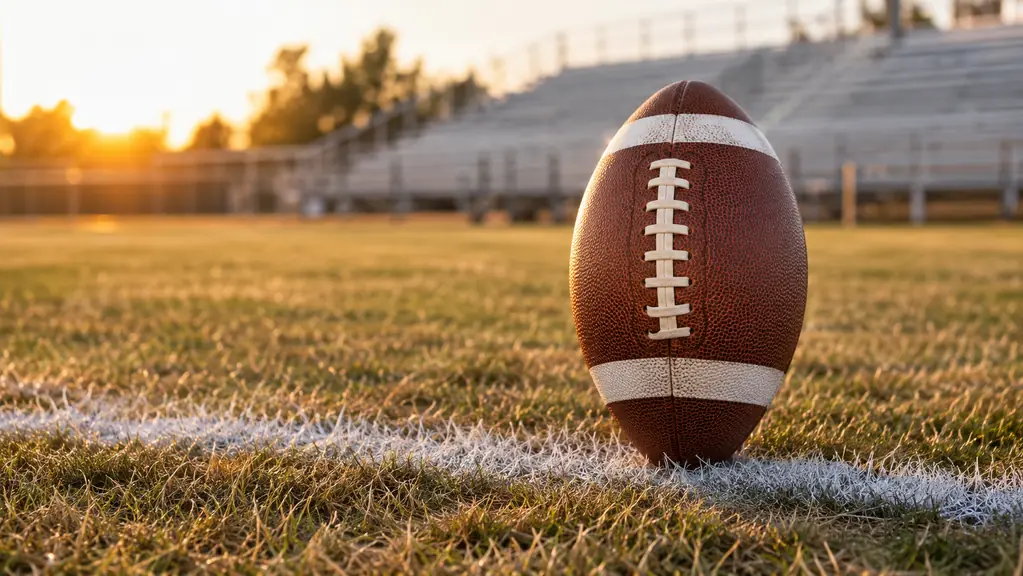
Every fall I end up with a plastic bin of footballs in the bed of my gray pickup, and every fall the same thing happens: the good balls get stolen by the varsity, the cheap ones get left in the rain, and by October I am standing on the practice field holding something slick and sad that will not take a spiral. Last June I bought a Wilson NFL Super Grip composite football to see whether a ball at that level could survive a JV season without turning into a brick.
Short version: it did. Five months, roughly forty practices, a hundred or so backyard sessions with my son Jalen, one cold front that dropped into the thirties, and the ball still has its pebbled texture and still throws clean. There are real limits, and I will get to those, but for a family buying one ball to last a few seasons, this is the one I point at now.
The Quick Verdict
A genuinely grippy composite ball that holds its texture through a full season of practices. Not a game-day leather ball, and the official size is too big for younger kids, but for ages 14 and up it is the safest money in the bin.
Amazon Check Today's Price →The ball that survived a JV season without getting slick
Composite cover, stitched construction, classic laces. If you have been replacing cheap footballs every couple of months, stop doing that.
Amazon Check Today's Price on Amazon →How I've Used It
I am 47, I coach the JV offensive line at a high school in Chattanooga, and I played a small-college ball myself, so I am not precious about equipment. Gear gets used or it gets tossed. This ball lived in the equipment bin in my garage, rode to practice in the truck, and came out for two things: offensive line hand drills, where I want a ball that does not slip out of a kid's hands when he is tired, and backyard throwing with Jalen.
For the linemen I use it for snap work and for a drill where they have to catch a short ball fired at their chest while staying low. That drill is brutal on a football. It gets dropped on gravel, stepped on, and thrown into a fence more times than I want to admit. The Wilson ball took all of it. The composite cover scuffed and picked up dirt, but the pebbling did not wear smooth, which is the thing that kills a cheap ball.
The first month is worth describing in detail because it is where most balls announce whether they are going to last. Our summer practices in Chattanooga start in the low nineties with humidity you can feel on the ball itself. I kept a cheap composite ball in the bin next to the Wilson on purpose, as a control, and by the third week of June the cheap one had a slick sheen across two panels where the pattern had rubbed down. The Wilson still looked and felt like the day I unboxed it. That was the moment I stopped thinking of it as a review item and started treating it as team equipment.
With Jalen it was normal work: route running in the backyard, deep balls, some one-handed catch drills, and a lot of him telling me I throw like a lineman. Which is fair. The ball is the official size, 11.36 inches around the long way, and it weighs just under a pound at 454 grams. That is the spec size for high school and college and it is labeled for ages 14 and up, which matters more than most listings admit.
One more usage note, because it surprised me. I started keeping it in the cab of the truck instead of the bed, on the floorboard behind my seat, so it was always there for a ten-minute throwing session in the driveway after work. That meant it lived through a lot of heat cycles in June and July, hot truck to cool evening air, over and over. Composite covers can get gummy when they sit in heat. This one did not. It felt the same in my hand on the fortieth day as it did on the first, and I think that has more to do with the cover material than with anything clever I did.
Feel and Grip: Where This Ball Earns Its Name
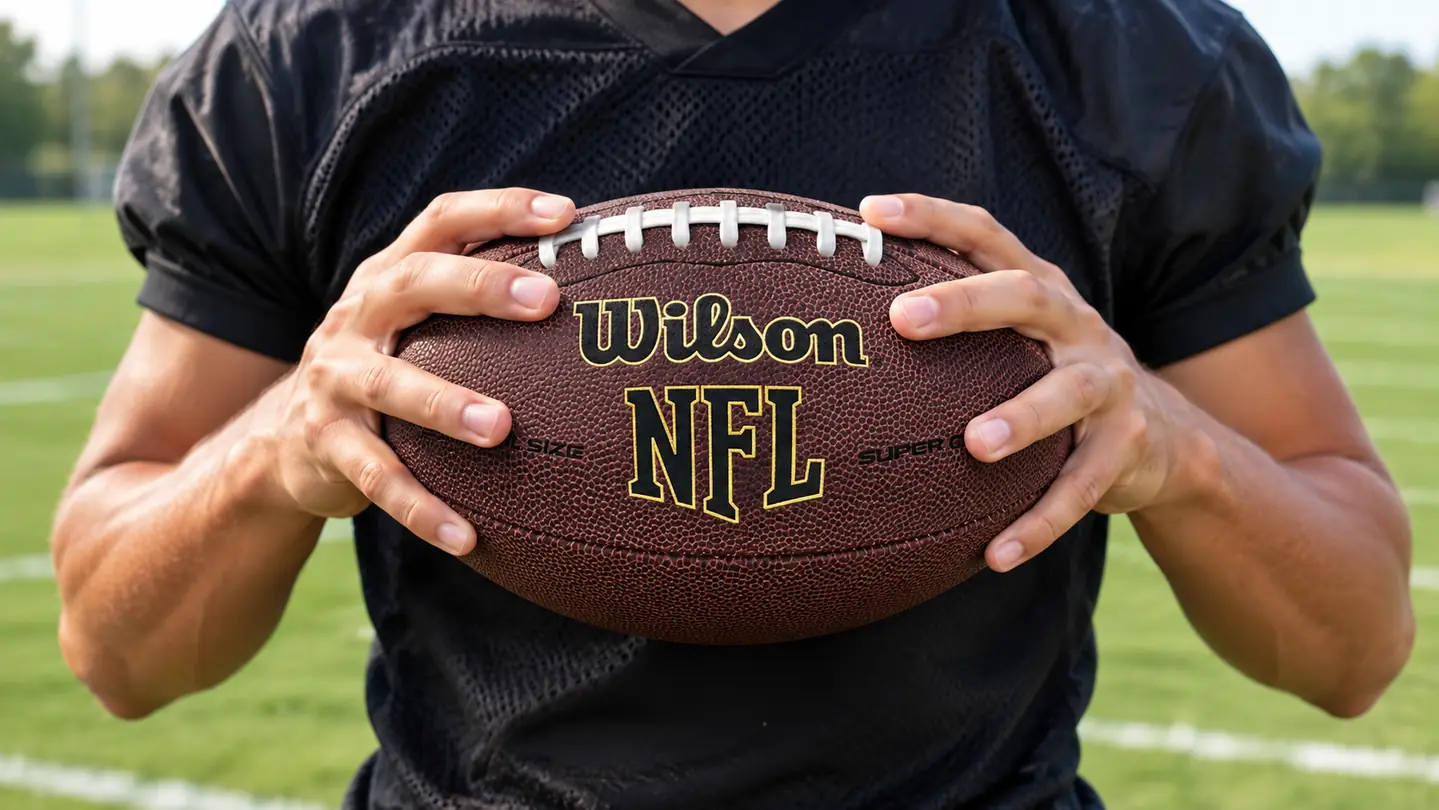
Here is the honest test for any composite football. Wet your hands, or wait for a humid Tennessee evening, and try to throw a ten-yard out. Cheap composite balls turn into a bar of soap. This one does not. The soft composite material has a raised pebble texture that stays tacky even after the ball has been handled all practice, and the stitching is real stitching, not a molded suggestion of stitching.
I ran a specific drill to test this in September, once the dew started sitting on the grass at 6 p.m. Two receivers, ten out routes each, one ball in dry conditions and one with water poured over it out of a jug. On the wet ball, the cheap control ball slipped out of my hand early twice and wobbled. The Wilson ball was a little slick for the first throw and then gripped fine once the water spread across the pebbling. That is the whole argument for this ball in one paragraph. It is not that moisture never matters. It is that the cover recovers instead of giving up.
The laces are the classic style, and I noticed them most with Jalen, who has smaller hands than a college quarterback and was learning to keep his fingers on the laces through his release. A ball with wide, flat laces lets a young player cheat his grip. This one makes him find the laces honestly. His spiral got noticeably tighter between July and October, and while I would like to take credit as a coach, the ball had something to do with it.
We also spent one afternoon in August doing nothing but grip work for a player on our line who has hands the size of dinner plates and was having trouble holding on to a shorter ball. He is a big kid and he was used to grabbing, not gripping. On the Wilson ball he could find the laces with his fingertips instead of his palm, and by the end of the session he was making catches away from his body instead of trapping the ball against his chest. That is not a ball review, that is a ball doing its job.
Composite covers are also softer than leather when they are new, and this ball broke in fast. Leather takes weeks. This one felt throwable after a couple of practices. The tradeoff is that soft composite can feel a little spongy if you are used to a broken-in leather ball, and a varsity quarterback will notice the difference immediately. For a practice ball, that softness is a feature, especially in cold weather.
Cheap composite balls turn into a bar of soap in humid weather. This one stayed tacky through forty practices.
Durability Through a Full Season
The construction is a composite cover over a butyl rubber bladder, stitched rather than glued, and that matters. The failure point on cheap footballs is almost always the seam, where the cover starts peeling back from the bladder and the ball develops a lump. I kept waiting for that. It did not happen.
What did happen: the ball lost air slowly over about three weeks, which is normal for any bladder and worth mentioning because people treat it as a defect. I topped it off with a pump every few weeks and it held. The cover scuffed to a dull finish and picked up a permanent gray stain on one panel from the gravel, but scuffing is cosmetic. The texture is what matters, and the texture held.
I checked the seam specifically, on purpose, at the start of every month. I would sit on the tailgate with my thumb through the stitching and run it all the way around, feeling for the soft spot where a cover starts to lift. In June the seam was tight and even. In August it was still tight, just dirty. In October I found one spot near the end of a seam where the edge of the cover had picked up a tiny nick, maybe an eighth of an inch, from being stepped on at the wrong angle. It never spread. By December it was still the same size nick. That is the difference between a cover that is stitched and one that is glued and molded, and it is why I trust this ball to a kid who is not careful.
The cold test was the one I actually cared about. In mid-November we had a morning that started around 34 degrees and I left the ball in the truck overnight on purpose, which is the kind of thing that ruins a cheap composite. It came out firm and a little slick for the first five minutes, then warmed up in my hands and threw fine. It did not crack, and the cover did not separate at the seams. If you live somewhere with real winters, keep it out of the garage in January, but a cold morning will not kill it.
The other abuse worth reporting is the fence drill. I have a bad throwing habit from my playing days and I drill the linemen by firing the ball at a chain-link fence from about eight yards, so it comes back at them hot. That ball hit that fence, ball side, hundreds of times between July and November. It also hit the paved edge of the driveway, a garage door, and once a parked mower. It has no crack and no flat spot. The worst thing you can say about it is that it looks like it has been used, which is exactly what you want a practice ball to look like.
Sizing: Read This Before You Buy
This is the official size ball, 11.36 inches, meant for high school and college and labeled ages 14 and above. Wilson also makes the same Super Grip in a junior size for 4th through 6th grade, roughly ages 9 to 12, and if you have a ten-year-old, buy that one instead. I have watched parents hand a full-size ball to a nine-year-old and then wonder why he is throwing ducks. It is not him. It is the ball.
At 454 grams, the weight is right for a player Jalen's age and up. For an adult rec player or a coach running drills, it feels correct in the hand. For anyone under about 13, it will feel heavy and the official diameter will make it hard to grip the laces properly, which is exactly the problem the junior size exists to solve.
I got this wrong myself, briefly. In June I handed a full-size Wilson to a rising sixth grader at our youth camp, a kid who was maybe 85 pounds, and he could not get his hand around the laces at all. He was carrying the ball like a loaf of bread. We swapped him to a junior ball and within two practices he was throwing a real spiral. Nothing about his mechanics changed. The object in his hands changed. If you take one thing out of this review, take that.
What I'd Change
Two things. First, the ball ships underinflated, which is standard but annoying when you want to throw the day it arrives. Budget for a pump and a pressure gauge if you do not already own them. I have an old pump in the truck for exactly this reason, and the first thing I did with this ball was put about eight pounds of air in it before Jalen and I could do anything useful.
Second, the listing occasionally shows a team name in the attributes that has nothing to do with the ball you get. Ignore that. This is a plain composite practice ball, not a licensed team ball, and if you are buying it expecting a logo, you will be disappointed. The value here is the cover and the construction, not the branding.
What I Liked
- Pebble texture stays grippy through a full season of practices
- Stitched composite cover did not peel or lump at the seams
- Broke in fast, throwable within a couple of practices
- Held up to a 34-degree morning without cracking or separating
- Survived hundreds of hits off a chain-link fence with no crack or flat spot
- Official size and correct weight for ages 14 and up
- Classic laces force young players to learn an honest grip
Where It Falls Short
- Official size is too big and heavy for players under about 13
- Ships deflated, so you need a pump before first use
- Soft composite feel will not satisfy a varsity quarterback used to leather
- Cover scuffs and stains permanently, which is cosmetic only
Who This Is For
This ball is for the parent of a middle school or high school player who is tired of buying a new football every other month. It is for the coach who needs a bin of practice balls that will survive a season of being dropped on gravel. It is for the adult rec player who wants a ball that feels right in the hand on a Sunday and does not need to be a game-day leather ball.
If you are buying for a household with multiple kids across a range of ages, buy this one for the teenager and the junior size for the younger kid. That combination covers almost every family I know and costs less than replacing two cheap balls per season. Wilson has been the official football of the NFL for over a hundred years, and while that is marketing, the construction quality on this ball backs it up in a way that the cheap composite balls do not.
It is also the right ball for the parent who is doing the backyard work with a kid who is not going to be a quarterback. Jalen plays linebacker, and most of what we do is not throwing at all. It is catching a ball fired at him in the driveway, getting low for a short hop, and learning not to let the ball get into his body. That kind of work happens hundreds of times a week in the summer, and it chews up equipment. A ball that survives it and still feels good on the occasional throw is exactly what a family at this stage needs.
Who Should Skip It
Skip it if your player is under 13. Buy the junior size. This is not a close call and it is the single most common mistake I see parents make. A ball that is too big teaches bad mechanics and kills confidence.
Skip it, too, if you are buying a game ball for a varsity or college-level player who is used to a broken-in leather ball. The composite cover is soft and forgiving, which is exactly what you want in practice, but it is not a leather game ball and it does not pretend to be. If that is what you need, look at a leather ball and pay for it. If you want one ball that will survive the backyard, the practice field and the equipment bin, buy this one.
One ball, one season, no replacement needed
Official size for ages 14 and up, stitched composite cover, and the texture is still there after five months. Order the junior size instead if your player is younger.
Amazon Check Today's Price on Amazon →