
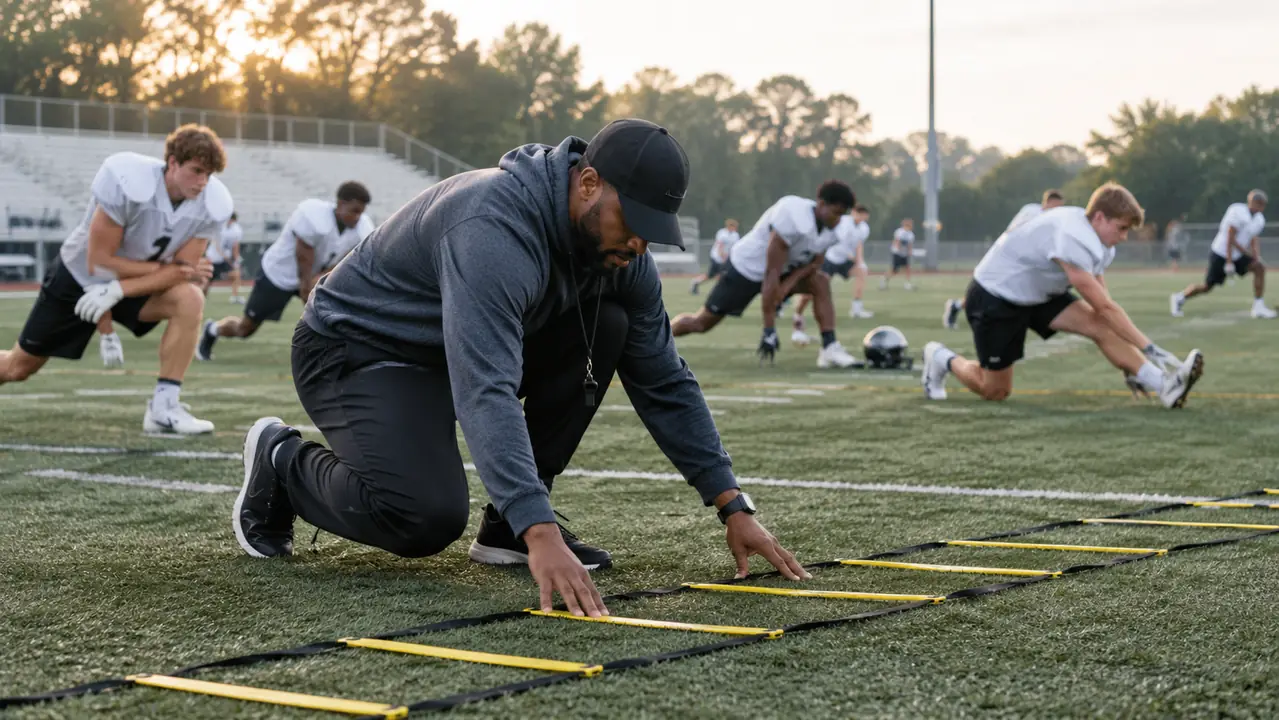
I coach the JV line at a high school in Chattanooga, and my gray pickup usually has a plastic equipment bin sitting in the bed. I played small-college offensive line before I started coaching, so I am picky about feet. Last September I stood on the practice field on a Tuesday and watched a sophomore guard lose his balance three reps in a row on a simple pull step. He was not tired and he was not being lazy. He simply did not have a repeatable second step, and nothing in that drill was telling him so. I walked him to the shed, pulled the GHB Pro Agility Ladder out of the bin, and set the rungs close together. Four reps later he felt the difference himself, which is worth more than anything I could have said from the sideline. When a parent stops me after practice to ask which footwork tool to buy, I give them the answer I would want if I were the one spending the money. The GHB ladder is the tool I keep in that bin because it sets a target for every single step. Cones are what I reach for when the drill needs open space, turns, or a line of players moving at once. Short answer: the GHB ladder builds cleaner feet in a short lane, and cones build movement in open space.
Here is the version I give at the fence. For a young player who is still learning to keep his feet under him, the 12 rungs on the GHB ladder do some of the coaching for you. The ladder is 20 feet long, the rungs are plastic, and each rung is 16.5 inches long. The space between rungs adjusts up to 15 inches. That means you can tighten the pattern for quick feet or open it up for a longer stride, and you can do it in about the time it takes to walk the length of the ladder. A cone drill can do a lot, but it does not force a player to put his foot in the same place on every rep. The ladder does. On a cone course, an athlete can stretch a step, round a turn, or drift a few inches wide and still finish the rep looking fine. On the ladder, the rung is either under his foot or it is not, and the miss shows up instantly. That single difference decides which tool belongs in your garage. The rest of this article is the detail behind that one line.
| GHB Pro Agility Ladder | Cones | |
|---|---|---|
| Footwork target | 12 rungs set a clear 16.5-inch window for each step | Open gaps, so a player can stretch a step and still clear it |
| Rung or gap spacing | Rung spacing adjusts up to 15 inches | Any distance you can pace off, with no upper limit |
| Setup on uneven grass | One long strip that can catch on a crown or bare spot | Each cone sits on its own spot and can be kicked two feet over |
| Portability | Comes with a carrying bag and lists at 4.8 ounces | A full set lives in a tub or mesh bag and takes up more room |
| Storage in the garage | The bag hangs on a hook or sits on a shelf | Cones stack in a corner or in the equipment bin |
| Drill variety | Comes with a drills guide for ladder patterns | Marks gates, turns, backpedals, breaks and finish lines |
| Group stations | One lane unless you own more than one ladder | One bag can mark several stations for a whole group |
| Durability and support | Plastic rungs and a lifetime manufacturer warranty | Cracked or lost cones are replaced one at a time |
| Bad-step feedback | A missed rung is obvious to the player and the coach | A wide gap can hide sloppy feet |
| Best for | Teaching a repeatable step pattern in a short lane | Open-field movement and conditioning with a group |
Where the GHB Ladder Wins
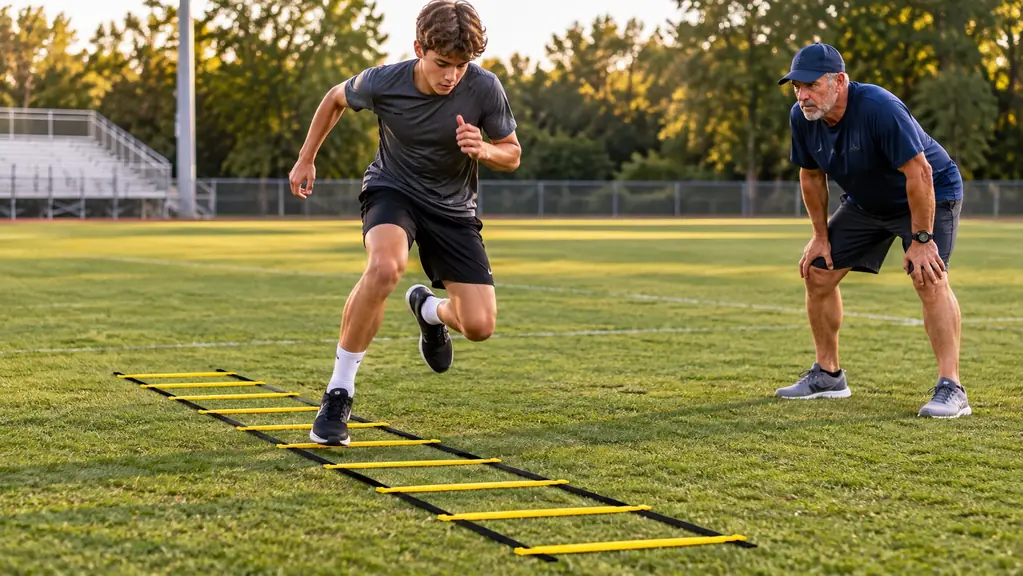
The first place the GHB ladder wins is repeatability. A linebacker who is learning to stay square, take on a block, and then scrape to the ball has to trust his feet in a tight space. When I set the rungs close, he cannot take a lazy step and still look fast. The rung is either under his foot or it is not. I can see it from the side without a video, and he can feel it without me saying a word. That feedback is worth more than another lap around a cone course, because a cone drill rewards the player who finishes, not the player who finishes correctly. I ran both with the same group last fall and the results were not close. On the cone course, two of my linemen looked sharp and one looked slow. On the ladder at the same spacing, the two who looked sharp were crossing their feet, and the one who looked slow had the cleanest pattern of the group. The ladder told the truth. The cones told me who could run. The GHB ladder also comes with a drills guide, which helps a parent who has never run a footwork session. You lay the ladder out, pick a pattern from the guide, and watch the feet.
The second win is adjustability and storage. The rung spacing adjusts up to 15 inches, so the same ladder works for a 15-year-old linebacker and for a younger sibling who is still learning the pattern. When I tighten the rungs for my son, I open them back up for a younger player in about two minutes with no tools and no instructions. The carrying bag matters more than it sounds. I put the GHB ladder in the bag, drop it in the truck bed next to the equipment bin, and do not think about it again until practice starts. The ladder is listed at 4.8 ounces, which makes it easy to carry from the garage to the backyard in one hand along with a water bottle. The plastic rungs and the lifetime manufacturer warranty also matter for a team that is hard on gear. I have watched cones crack in cold weather in November and vanish into the field house by December, and nobody ever fesses up to it. A ladder that folds into a bag is harder to lose, and when it is time to work, it is already where I need it.
Where Cones Win
The first place cones win is setup on real grass. Our practice field is not a golf course. There is a bare spot near the 30-yard line, a crown in the middle, and a seam where the grass meets the track. A ladder wants a flat strip. If the ground is uneven, the edges can catch a cleat, and the fix is not a two-second kick. I have to pick the whole ladder up, walk it ten feet downfield, and lay it out again, and by the time I do that the drill has lost its rhythm and half the line has started talking. Cones sit on the ground one at a time. If a cone lands on a bad spot, I kick it two feet to the side and the drill keeps moving. On a wet Thursday in October, I gave up on the ladder entirely and set a five-cone pattern because the ground was too soft to hold a straight line. For a coach with 20 minutes and 18 players, that flexibility is not a small thing. It is the difference between a drill that runs and a drill that stops every two minutes for a fix.
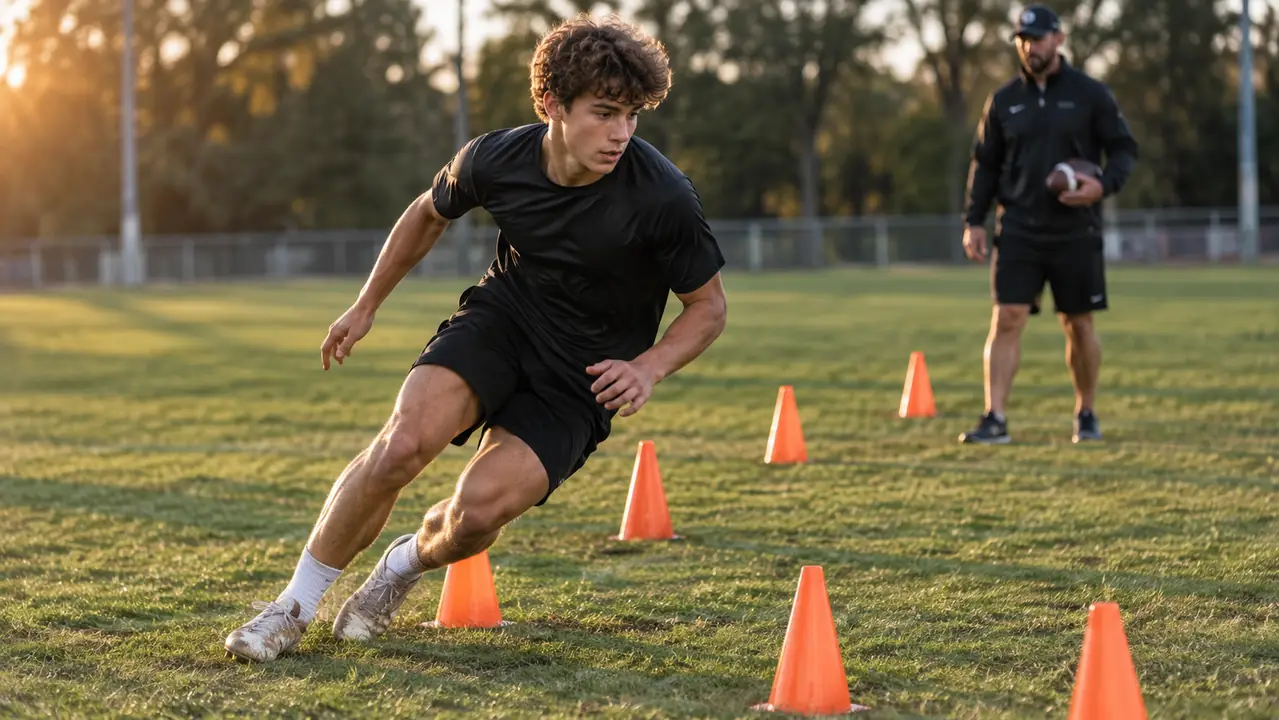
The second place cones win is open-field work and group size. A ladder is one lane. Unless I own several ladders, one player goes at a time and the other seventeen stand in line watching him. A bag of cones can mark a gate, a turn, a backpedal, a break on the ball, and a finish line, and it can do all of that across three stations at once. Cones also let me set any spacing I want, with no 15-inch limit and no rungs to count. If I want a long stride drill for a receiver or a tight turn for a linebacker, cones do that without arguing. They also let a player react to something instead of memorizing a pattern. I can point at a cone and have him cut, and he has to read it in real time, which is closer to what happens on a Friday night than any pattern I can draw on the ground. The GHB ladder is a precision tool. Cones are a volume tool. Most weeks, a football team needs both, and the mistake is buying one and pretending it does the job of the other.
Give your player a lane that teaches clean steps
The GHB Pro Agility Ladder gives you 12 plastic rungs, 20 feet of runway, and rung spacing that adjusts up to 15 inches. It comes with a carrying bag and a drills guide, so a parent can run a real footwork session in the backyard without guessing. Lay it out, pick a pattern from the guide, and watch the feet.
Amazon See the GHB Ladder on Amazon →A ladder makes a bad step obvious. Cones make a good player find space. I use the GHB ladder when I want the feet corrected, and cones when I want the whole group moving.
Who Should Buy Which
Buy the GHB ladder if you are a parent or a position coach working with one to four players on footwork. It is also the better first tool for a young player who has never been taught a step pattern, because the ladder gives him something to hit instead of something to remember. The 12 rungs, the 16.5-inch rung length, the adjustable spacing up to 15 inches, the carrying bag, and the drills guide give you a complete session without a lot of setup. If your player is a linebacker like my son Jalen, 15, a sophomore linebacker, the ladder helps with the short, choppy steps he needs to stay square and shed a block. I keep the rungs close for him and open them up when he works on his get-off, and the change takes about two minutes. If you are coaching a whole line, one ladder is not enough for a station rotation, but it is a good teaching tool at the front of the line before the group drill starts.
Buy cones if you need to move a group, mark open-field drills, or work on turns, breaks, and reaction. Cones also make more sense if your only flat space is a driveway or a gym floor and you do not want to fight a ladder that will not sit still on a seam or a slope. The honest answer for most football families is to start with one ladder and a small set of cones. The GHB ladder is the piece that teaches the footwork. The cones are the piece that lets you take that footwork into space. If you can only buy one, buy the tool that matches the problem you actually have. If the feet are the problem, buy the GHB ladder. If space and group size are the problem, buy cones.
I keep both in the garage for a reason. The GHB ladder is what I hand a player when I want him to feel a correct step without me talking over him. The cones are what I hand a group when I want them to move, breathe hard, and make cuts without waiting in a long line. A parent can get a lot done with one ladder and a handful of cones, and the order matters less than the purpose. Use the ladder to teach the step, then use the cones to see whether the step survives when the player has to think, turn, and react. That is how footwork shows up on Friday night, and it is the only test that counts.
Start with the tool that fixes the feet
The GHB Pro Agility Ladder is 20 feet long with 12 plastic rungs, rung spacing that adjusts up to 15 inches, a carrying bag, and a drills guide. Set it up in the backyard for short sessions, then take the same steps to the practice field on Tuesday.
Amazon Check the GHB Ladder on Amazon →