
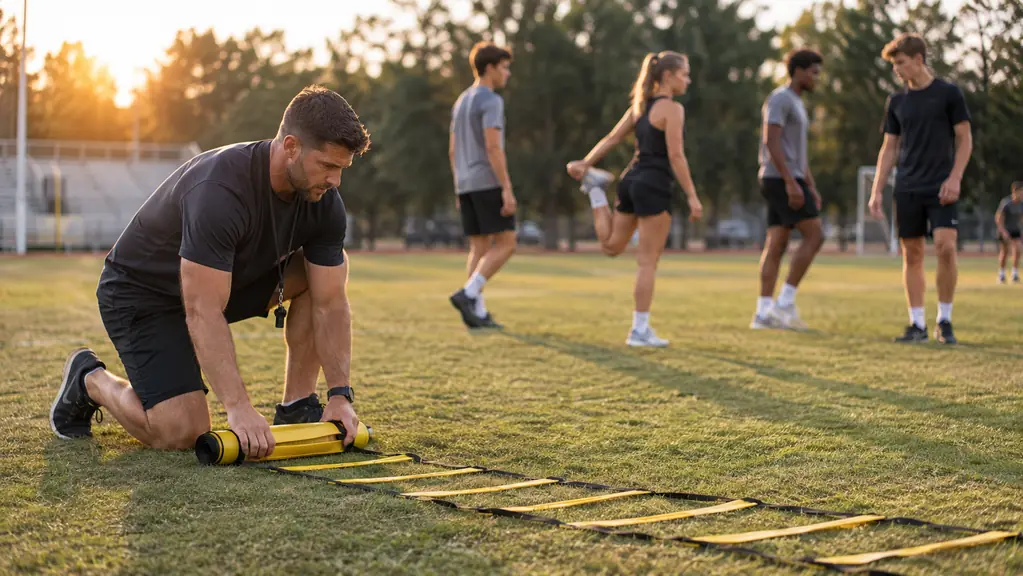
The first agility ladder I bought for our JV program lasted four practices. By the second week the rungs had twisted into a zigzag and the rails were fraying where cleats kept catching them. I spent one fall taping a ladder onto the garage floor with athletic tape, which worked right up until the first rainy Saturday. So when I say I have been through a few of these, I mean it. The GHB Pro 20 ft ladder is the one that stayed in the equipment bin for a full season, three days a week, with 15 and 16 year olds who are not gentle with anything they step on.
I coach the JV line at a high school in Chattanooga, and footwork is most of what we do in the first twenty minutes of practice. Not because it is fancy. Because a lineman who takes a short, wrong first step is beaten before he ever puts his hands on anybody. Cones work for that up to a point. Tape works until it rains. A ladder gives every single step a fixed target, which is the whole argument for owning one. What follows is what a season with this specific one looked like, what held, and where I still get frustrated with it.
The Quick Verdict
Twelve rungs, twenty feet, spacing that opens to fifteen inches, and 4.8 ounces of plastic that survived a full season of cleats. The bag and the drills guide are afterthoughts. The ladder is not.
Amazon Check Today's Price →The one piece of footwork gear that came back out of the bin every week
Adjustable rung spacing from tight to fifteen inches, twelve rungs, twenty feet end to end, and a carrying bag that fits behind the seat of a pickup.
Amazon Check Today's Price on Amazon →How I've Used It
We lay it out on the practice field on Tuesdays and Thursdays, around 4:15, before the varsity takes the field. Fifteen minutes with the linebackers and the linemen, then it goes back in the bin. I run the same ladder in the backyard with Jalen on Saturday mornings when he wants extra work on his first step, and in the garage when the weather will not cooperate. That is three surfaces, three very different amounts of grip, and somewhere north of thirty sessions since August.
The first thing I noticed is that twenty feet is longer than it sounds. Twelve rungs at the spacing we use covers enough ground that I can run two groups at once, one entering from each end, without anybody standing in a line. With cones I was always resetting them between reps. With this I lay it down once and coach. That single change is worth more than any drill in the included guide.
Before this one I tried the cheap route: a thirty foot roll of flat rope ladder off a hardware site, no rungs, just webbing with knots tied in it. It lasted two practices. The webbing stretched, the knots went soft, and by the end of the week the spacing was so far off that the drill was teaching bad steps instead of good ones. The GHB fixed that with rigid rungs. A player's foot either hits a rung or it does not, and he knows which before the next rep starts. That is not a small thing when you are coaching fifteen kids at once and cannot see every foot.
The second thing is that the rungs stay where I put them. On a dry field the rails hold their spacing through a full session of guys stepping on them and through them. I check with a tape measure every couple of weeks, and the spacing has not drifted more than an inch anywhere along the length. For something that weighs 4.8 ounces and rides in the bed of a gray pickup, that is better than I expected.
The third thing is how the players treat it. It is plastic and nobody babies it, which is exactly what you want out of practice equipment. It gets thrown in the bin, thrown out of the bin, walked on, stepped over, and once used as a barrier in a drill it was never designed for. It has not complained yet, and when I pull the bin out of the truck I do not have to think about whether the ladder inside survived the ride.

Setup, Rung Spacing, and the Numbers That Matter
Setup on the GHB ladder takes under a minute. Unroll it, straighten the rails, slide the rungs to where you want them, done. Each rung is 16.5 inches long, twelve rungs, twenty feet end to end, and the gap between rungs adjusts anywhere up to 15 inches. That is the whole product, and it is enough.
The adjustment is the part I would pay attention to if you are buying for a younger player. Fifteen inches is a big ask for a 15 year old, so for the first couple of weeks of a season I run it tight, closer to 12 or 13 inches, and widen it as the footwork cleans up. Same ladder, same drills, different demand. Late in the year when the group got sloppy, I closed the spacing back down and made them earn the wide setting again. That is the difference between a ladder and a painted line on a floor.
Packed up, it measures roughly 17 by 4.6 by 1.7 inches and slides into the carrying bag that comes with it. A drills guide comes in the box too. I read it once. It is fine for a parent starting from zero and not much use to a coach who has been running ladders for twenty years, and that is not a criticism so much as an honest description of who it was written for.
What Held Up Over a Season
Cleats are the test. Rubber cleats chew plastic rungs, and molded cleats are worse. After a full season the top faces are scuffed, and there is a small crack at the edge of the third rung from the end that has not spread and has not changed how the ladder sits. Nothing has broken. Nothing has come apart at a joint. For a ladder stepped on by fifteen kids a session, that is a passing grade.
There was one afternoon in late September worth mentioning, because it was the hardest test the ladder got. We had a line of storms come through about twenty minutes into practice, and instead of calling it we moved the footwork under the shed and kept going. Wet cleats, wet plastic, a concrete slab. That was the session where the sliding problem showed up at its worst, and it was also the session where nothing broke. Two different questions, two different answers.
The rails were the part I watched closest, because the rails are where my last ladder failed. They have held. Folding it and rolling it back out twice a week for four months has not produced a kink or a fray. The plastic has taken a set from being stored rolled, and it lays flatter after the first few minutes on grass than it does straight out of the bag. The bag has held too, though the material is thin and I would not expect it to outlast the ladder by much.
The warranty is a lifetime manufacturer warranty. I have not had to use it, which is the only honest thing I can tell you about a warranty I have never tested.
Midseason I did a check on the whole thing, rung by rung and joint by joint, looking for the kind of wear that turns into a failure in November. I found scuffing and nothing else. That is the report.
Twelve rungs at 16.5 inches, spacing that opens to 15 inches. The useful part is not the length. It is that I can widen the ladder as the footwork gets better instead of buying a second one.
Drills We Actually Run With It
We keep it to four drills, because four done well beat twelve done badly. One foot in each square, walking pace first, then game speed. Two feet in each square, same progression. A lateral in and out, which is the one that actually resembles a pass rush move. And a weave where they go in and out of the rungs the length of the ladder and sprint out the far end.
On the wide setting we run a get-off drill: first step only, one rung, explode, reset. Twelve rungs means twelve reps before we rotate, which is about right for a group of six. That is a better use of twelve rungs than turning the thing into a conditioning circuit, which is what I see a lot of people do with a ladder this long.
The lateral drill is where the adjustable spacing earns its keep. At fifteen inches a 15 year old has to reach for the step. At twelve he has to be quick. When we spent three weeks getting beat off the edge, I closed the spacing and ran the lateral drill tight until the feet got faster, then opened it back up. That is a coaching decision the ladder let me make without buying a second piece of equipment.
Here is the piece I would add to that. Two feet in each square is the drill that separates the kids who have done the work from the kids who have not, and it is also the one where a wide setting punishes you. I run it at twelve inches for the whole group, then widen it only for the players who earned it. Nothing scientific about that. It is just what the ladder lets me do in the time it takes to walk the length of it between reps, which is not something I could ever say about cones.

Where It Falls Short
On wet turf and on a gym floor, the rails slide. There is nothing in the kit to pin them down, so on a wet Tuesday I have watched the whole ladder walk two feet to the left over the course of a session. My fix is to have a player stand on each end rail between reps. It works. It is also annoying, and if you train alone on a smooth surface you will need your own solution.
The sliding is actually worse in a gym than on wet turf, if you can believe it. We ran it once in the aux gym in January when the field was frozen solid, and by the end of twenty minutes the ladder had drifted so far to the right that the last drill was running at an angle to the wall. Nobody got hurt and the drill still worked. But it was not the same drill anymore, and I had to stop and straighten it twice to keep it honest.
Twenty feet of ladder needs twenty feet of flat ground. That sounds obvious until you get it home. My backyard slopes, and I can only lay out about fourteen feet of it before the ground falls away, so the backyard work is shorter than the field work. Plenty of parents are going to run into the same thing, and it is worth measuring your space before you order.
The bag is thin and the drills guide is basic. None of that changes what the GHB is: twelve rungs, two rails, and twenty feet of space. The bag and the guide are packaging. The coaching is still yours.
What I Liked
- Twelve rungs over twenty feet means two groups can work at once without a line
- Rung spacing adjusts up to 15 inches, so one ladder covers a 15 year old and a varsity lineman
- Rungs hold their spacing through a full session on dry ground
- Packs to roughly 17 by 4.6 by 1.7 inches and weighs 4.8 ounces
- Lifetime manufacturer warranty, and nothing on it broke in a season
Where It Falls Short
- The rails slide on wet turf and on gym floors, and nothing in the kit pins them down
- The carrying bag is thin and will likely fail before the ladder does
- You need twenty feet of flat ground to use the full length
- The included drills guide is basic
Who This Is For
This is for the coach or the parent who is running footwork three times a week and is tired of resetting cones. The twenty foot length is the selling point if you have two or more players to work, and the adjustable spacing is the selling point if you are working with younger kids and want the ladder to grow with them.
It is also for the player who wants extra work on his own. At 4.8 ounces packed into a bag the size of a folding chair, it goes in a truck, a trunk, or a duffel without a second thought. Jalen carries it out to the field himself and has never once asked me for help with it, which tells you most of what you need to know about the weight.
Who Should Skip It
Skip it if your training space is short. A twenty foot ladder in a fifteen foot driveway is a fifteen foot ladder with five feet of extra plastic to trip over. The adjustment helps with rung spacing, not with overall length. Measure first.
Skip it if you train exclusively on a gym floor and you want something that stays put the moment you set it down. This does not. It needs weight on the ends or a dry field and a still day.
And skip it if you are buying it for the drills guide. The guide is a starter sheet. The value here is the rungs and the rails, and if you already know what you want to run, you are buying exactly the right thing.
One last thing, because it is the kind of thing that gets left out of reviews. Equipment that survives a season with a JV program is not the same as equipment that impresses you on day one. This one did not impress me on day one. It was a plastic ladder in a bag. What impressed me was pulling it out in November and finding it in the same shape it was in August, same spacing, same rails, same twelve rungs, and knowing I would not be buying another one in the spring.
Still resetting cones between reps? This ends that.
Twelve rungs, twenty feet, adjustable spacing up to fifteen inches, 4.8 ounces packed. It went back in the bin every week for a full season without a single failure.
Amazon Check Today's Price on Amazon →