
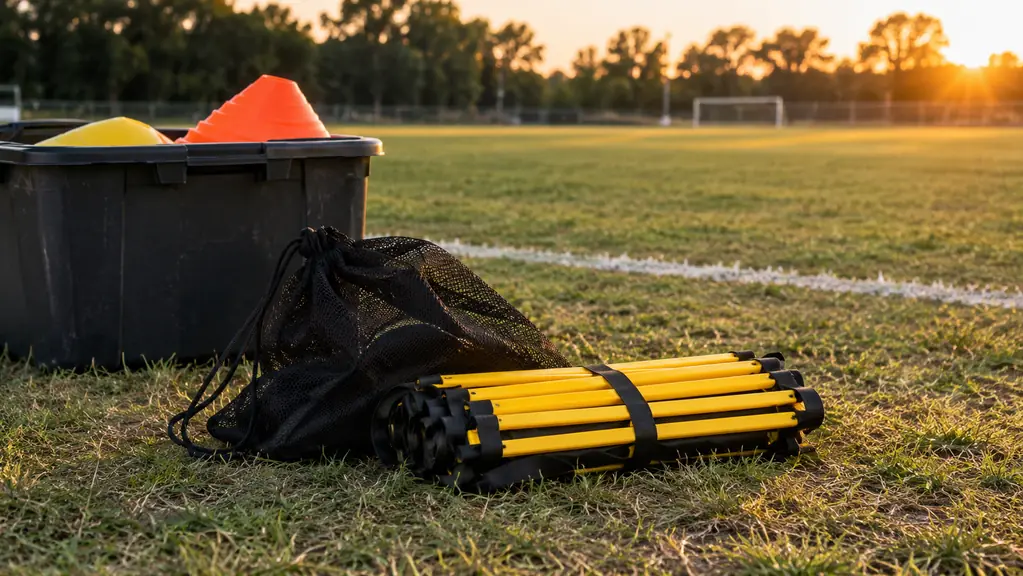
Two seasons ago I bought the GHB Pro Agility Ladder for one reason: our JV linebackers could not stop crossing their feet in the first five yards of a drop. Twelve rungs, twenty feet, a bag, a drills guide. That is the entire product. No app, no sensor, no numbered dial on the side. Just plastic rungs strung on two straps.
Here is what nobody tells you about a ladder like this. The ladder is not the training. The ladder is a measuring stick for how much a player wants to be coached. Get that straight and the GHB ladder is a good buy. Get it wrong and it hangs in the field house for a year and a half while everybody walks past it.
I am Desmond Pryor. I coach the JV line at a high school in Chattanooga, and I played offensive line at a small college longer ago than I like to admit. I am not a speed coach and I do not pretend to be one. What I am is the man who owns the equipment bin, which means I am the man who finds out what breaks. This review is about what broke, what did not, and the two things about this ladder that still irritate me.
The Quick Verdict
A plain, tough twenty-foot ladder that does the job it advertises. Plan on buying four stakes, because they are not in the box.
Amazon Check Today's Price →The Ladder Is Fine. The Missing Stakes Are the Whole Story.
Twelve rungs across twenty feet, each rung 16.5 inches long, spacing adjustable up to 15 inches, and a bag that rolls up shorter than your forearm. Stake it down and it stops moving.
Amazon Check Today's Price on Amazon →How I've Used It
The ladder lives in a plastic bin in my garage next to the spare girdles and the hand shields. Twice a week it rides in the bed of my gray pickup to the practice field. It gets unrolled on grass that is mostly weeds by October, and on the turf inside the field house when the weather turns. It has never been stored carefully. It has never been cleaned. The GHB ladder has been rained on, stepped on, and dropped off a tailgate more times than I can count.
In two seasons I have run something like sixty sessions with it. Warm-up footwork for the linebackers, lateral work for linemen who have to move their feet on a pull, and one station in our summer conditioning circuit. Nothing fancy. I also loaned it to a parent who wanted to work with his son in the backyard, and it came back whole, which is more than I can say for most of what leaves my bin.
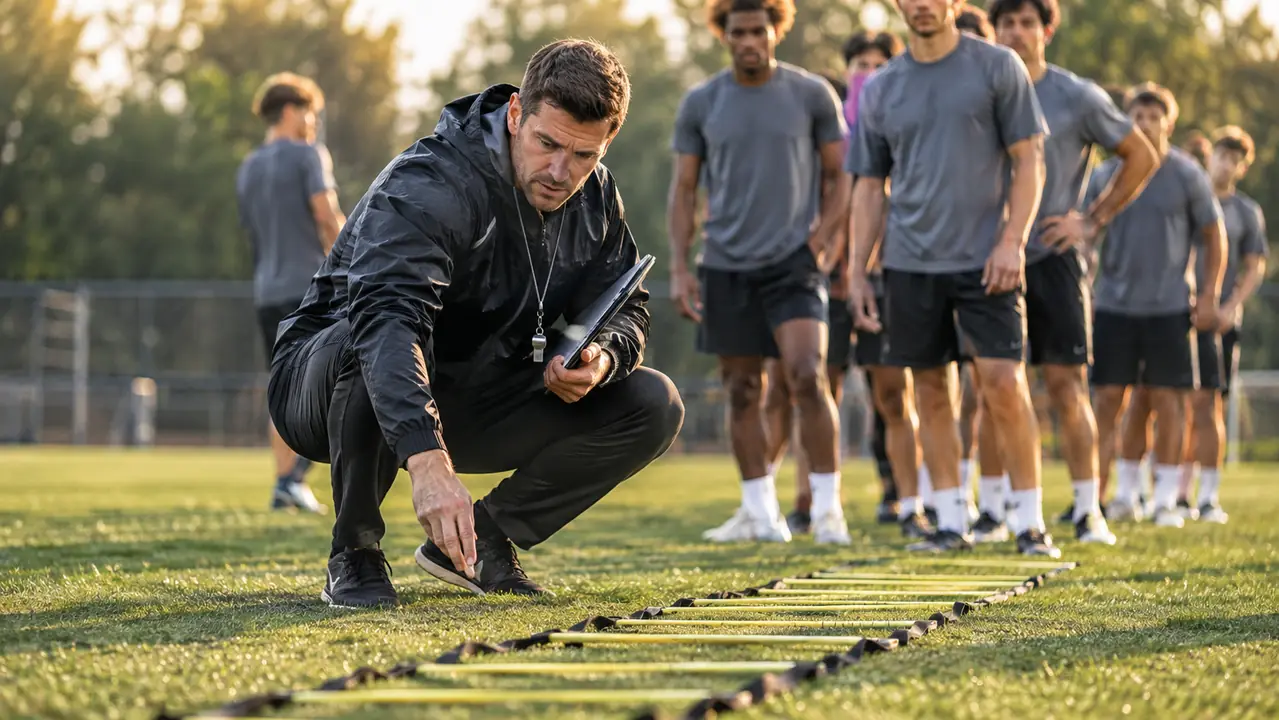
The first Tuesday in September is the session I keep coming back to, because it is the one where the ladder earned its place. We had eighteen minutes of practice left before the varsity took the field, and I had a group of six linebackers who had spent the whole week drifting on their first step. I unrolled the ladder at the far end of the field, set the corners, and ran four reps each of in-and-out and then lateral. Eighteen minutes. By the end of it the kid who had been crossing over all week was not crossing over anymore. That is not a coincidence and it is not the ladder doing the coaching. It is repetition with a visible target. The ladder just made the target visible and made the mistake obvious to everybody standing in line, including the kid making it.
My son Jalen is a sophomore linebacker, so I have a second data point that is not a coach's data point. He is fifteen and he is hard on gear in the specific way fifteen year olds are hard on gear, which is to say thoughtlessly. He has stepped on this ladder, dropped it off the tailgate, and left it out in the rain once. It still works. The bag smells like a wet sock that has given up.
That is the honest shape of it. This is not a piece of gear you will baby, and it does not need to be babied. The question is whether it does anything a set of cones cannot do, and the answer is yes, in one narrow way I get to further down.

The Rungs Do the One Thing You Need
Each rung is 16.5 inches long, and that number matters more than most people think. A ladder that runs narrow forces a player to move like he is on a balance beam, and you spend the whole rep correcting his feet instead of his hips. At 16.5 inches a grown linebacker in cleats can land in the middle of a square without thinking about it, which frees you up to yell about the thing you actually came out there to fix.
Two seasons back I borrowed a ladder from the head coach of the middle school team because I had left ours sitting in the garage. His was a narrower build, closer to 13 inches across, and I watched a 210 pound guard spend an entire drill trying not to clip the straps. His feet got slower, not faster, because all of his attention went into staying inside the rails instead of driving off the ground. I gave it back the same afternoon and made sure the GHB ladder was in the truck for the rest of the season. Sixteen and a half inches is not a luxury. It is the difference between a drill about foot placement and a drill about not falling over.
The rungs are plastic. I want to be plain about that word, because some listings dance around it. They are not padded. They are not rubber coated on top. If a player catches one with a cleat at full speed it will slide out from under him. It will not shatter. But on grass, an unstaked ladder will walk four feet to the left in about four reps, and the fifth kid in line will catch the slack and go down.
The spacing between rungs adjusts up to 15 inches. I keep most of it tight for quick feet and open a few squares wider when we work on the second step of a drop. You adjust by sliding rungs along the straps, which takes about thirty seconds for the full ladder once you have done it twice. It is not a precision adjustment and nobody out there is measuring to the sixteenth of an inch.
Twenty feet is the right length for what we do. Twelve rungs at speed gives you a rep long enough to see a mistake repeat itself, which is the whole point of a ladder. A shorter ladder lets a kid muscle through one bad step and hide it from you. A longer one just adds conditioning to a drill that is supposed to be about foot placement.
Stakes, and the Thing the Box Does Not Hand You
The ladder does not come with stakes. Read that again if you plan to use it on grass, because it is the biggest gap between what people expect and what actually shows up. The box has the ladder, a drills guide and a carrying bag. That is the list. There is no fourth item hiding under the cardboard.
My first session was a mess. A linebacker ran through and dragged the whole ladder four feet sideways, the next kid caught the slack and went down, and I spent five minutes untangling straps instead of coaching. I walked to the shed and came back with four landscape stakes left over from a project my neighbor quit halfway through. Two at the front corners, two at the back. The problem was gone.
Second session I came prepared. I stopped at the hardware store on the way to practice and picked up a pack of six inch landscape staples, the kind people use to pin down weed fabric. They live in the bin now in a sandwich bag with the whistle lanyards. Four go in, one at each corner, and the straps stay put for the entire drill. The other two are spares, because a stake pulled out of wet ground and lost in the grass is a thing that happens roughly once a month. If you are setting up in a backyard, push them in at an angle rather than straight down and they hold better. Ten minutes of fiddling the first time and then you never think about it again.
So count the stakes as part of the purchase. On turf or in a gym you will never need them. On grass you need them for any drill faster than a walk, and a piece of gear that sends you to the hardware store deserves to say so on the front of the box.
Two at the front corners, two at the back, and the ladder stops walking. That fix is not in the box, and it is the difference between a good session and twenty minutes of untangling.
What Wears Out First
The straps, not the rungs. After two seasons the webbing on the outside edges has gone soft and fuzzy where cleats have caught it, and one rung now slides more freely than the others, so I reset it before each session. None of that has stopped a drill. It is the kind of wear that makes the ladder annoying to set up rather than useless, and there is a real difference between those two things.
The rung that loosened is the fourth one from the front, and I noticed it in the second week of October last season. What happens is that the strap slides through the slot in the rung and the square gets wider than the one behind it. You can feel it when you walk the ladder out, the spacing goes uneven. I reset it by hand before every session now, which takes about four seconds, and I have thought about putting a wrap of tape on the strap on either side of the rung to pin it. I have not, because four seconds is four seconds and I usually have a whistle in my mouth and a clipboard in one hand.
Everything else has held. The rungs have not cracked, which surprised me given how much of the season they spend on ground that is half frozen. The carrying bag is thin but it has not torn at the seam. The drills guide is a folded sheet in a plastic sleeve and it is still legible, mostly because nobody has ever taken it out of the bin.
The listing puts the whole thing at 4.8 ounces and about 17.04 by 4.61 by 1.73 inches in the package. That tracks with what I see. It rolls into a bundle shorter than my forearm and light enough that a fifteen year old carries it in one hand with a water bottle in the other. There is also a lifetime manufacturer warranty, which for a piece of plastic you drag across a field is a strange and welcome thing. I have not had to test it and I hope that stays true.
For what it is worth, the failure I keep waiting for has not happened. I have watched two ladders from other brands crack at the joint where the strap meets the rung inside a single season. The GHB ladder has bent nothing and lost nothing. If it dies next October I will come back and say so.
Grass, Turf, and What This Actually Trains
A ladder is a footwork tool. It does not make anybody faster in a straight line, and if a parent tells you it will drop a forty time, that parent is selling something. What it does is force a player to put a foot down where he is told to put it down, over and over, until the pattern sticks when he is tired and does not want to think. That is dull and it works.
The drills guide covers the standard patterns. In and out, lateral, in-in-out. I used about four of them and built the rest around what our defense actually asks the linebackers to do. If you are a football parent working with one kid in a backyard, the guide is enough to get you started on a Saturday morning. If you already coach, you will glance at it once and hand it to a player.
On turf it behaves well. It grips enough that nobody has slid it yet and the plastic does not scuff the surface. On wet grass it is slipperier than I like, so the first session after a rain goes inside. That is not a defect in the ladder. That is what water does to a flat piece of plastic and a pair of cleats.
One more honest note. If your players wear molded cleats and you run this on baked August grass, the rungs will pick up scratches fast and the webbing will go gray. Cosmetic, all of it. The only thing I would genuinely change is the rung surface. A thin rubber strip down the middle of each rung would cut the sliding problem in half and would probably add very little to the build. That is my main gripe and it is a small one.
What I Liked
- Twelve rungs across twenty feet, long enough for a rep that exposes a bad habit
- 16.5 inch rung width fits a grown player in cleats with room to land
- Rung spacing adjusts up to 15 inches in about thirty seconds
- Rolls to roughly 17 by 5 inches and carries in one hand at 4.8 ounces
- Lifetime manufacturer warranty on gear that gets dragged across a field
Where It Falls Short
- No stakes in the box, so grass sessions need four of your own
- Unpadded plastic rungs catch a cleat and slide out from under a player
- Webbing softens and one rung loosens after two seasons of regular use
- Drills guide is thin if you already coach and know the patterns
Who This Is For
This is for the football parent who wants one tool to work on footwork with a kid in the backyard, and for the youth or JV coach who needs a durable ladder that lives in a shared bin and gets handled by people who did not pay for it. It is also fine for adult rec players who want to stop looking like they are running in wet cement. If you are willing to buy four stakes and put them in, this ladder will do everything you need it to do for a long time.
Who Should Skip It
Skip it if you need a ladder that works on grass straight out of the box with no extra parts, because this one does not. Skip it if you only train indoors on a smooth floor, since the sliding problem goes away but the ladder is overkill when tape on the gym floor does the same job. And skip it if you are shopping for speed. Nobody got faster because of a ladder. They got better feet, and then a coach taught them how to run.
Buy the Ladder, Then Go Find Four Stakes
Twelve plastic rungs, twenty feet of strap, adjustable spacing, a bag, and a lifetime manufacturer warranty. Do the stake part yourself in the first ten minutes and this thing earns its spot in the bin.
Amazon Check Today's Price on Amazon →