
Twenty minutes is not much time. That is exactly why it works. Most of the ladder work I see at practice dies in the first ten minutes, because nobody decided what the last ten were for. A player runs through a few patterns, the feet slap the grass, somebody yells faster, and then everyone stands around waiting for the next drill. Three weeks later the ladder is leaning against the garage wall and nobody has gotten any quicker.
A useful agility block does not need to be complicated. It needs to be short enough that a 15-year-old will actually do it on a Tuesday in October, and structured enough that the reps mean something. That is the design goal: a warm-up, three patterns, a change of direction, and a sprint finish, all inside 20 minutes, three times a week. The ladder I keep in the equipment bin for this is the GHB Pro Agility Ladder 12 Rung 20ft. It is 20 feet of straight line, the rungs are 16.5 inches wide, and the spacing adjusts up to 15 inches, which is enough range to take a player from week one to week eight without buying anything else.
The 20-foot ladder that lives in my equipment bin
Twelve rungs, adjustable spacing up to 15 inches, a carrying bag, and a drills guide in the box. It sets up in under a minute, packs down small, and it has ridden in the back of a pickup for a full JV season.
Amazon Check Today's Price on Amazon →Step 1: Set the ladder up right, then warm up for four minutes
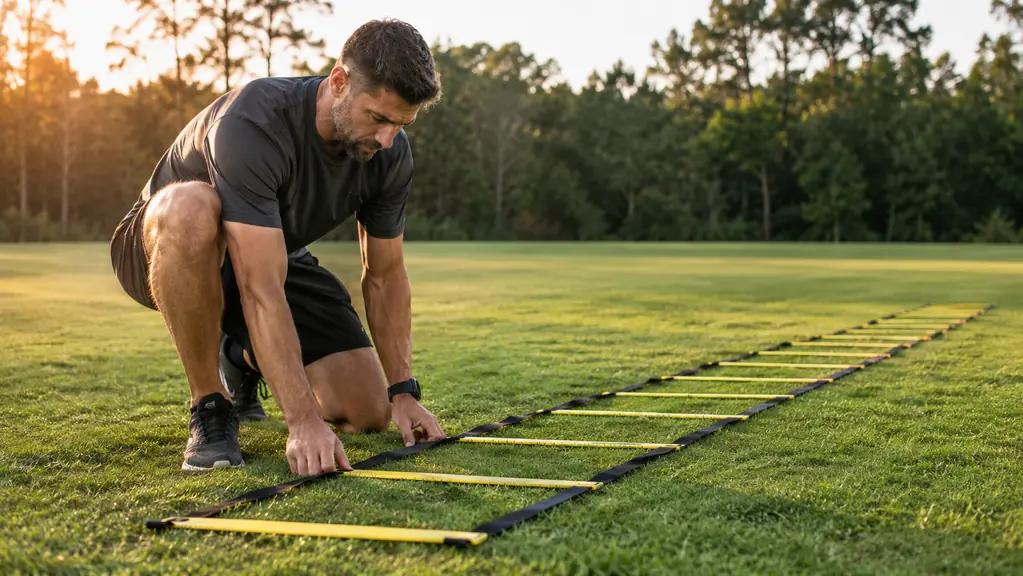
Rung spacing is the first thing to get honest about. The GHB ladder opens up to 15 inches between rungs, and most players should start narrower than that. I set it around 12 inches for a player learning the patterns and widen it toward the full 15 as the feet get quieter. Wide spacing rewards a long, sloppy stride because the player has room to reach. Narrow spacing exposes the feet, which is exactly what you want in week one. The first fall I used this thing I strung it all the way out to 15 inches, because that is what the drill videos look like, and the kid went through the whole 20 feet in about nine seconds and learned nothing. He was reaching, not stepping. I pulled a tape measure out of the truck, reset every rung to 12 inches, and the same player suddenly had to put his feet somewhere specific. That was the whole fix, and it took four minutes.
Surface matters more than parents expect. Flat grass or turf, not concrete, not a driveway, and not the crowned edge of a field. Twenty feet of ladder on a slope teaches a player to run on a slope. Lay it in a straight line on level ground, and if the grass is wet, shorten the pattern and accept slower feet for the day.
Then four minutes of warm-up, no negotiation. Two minutes of easy jogging and skips, leg swings forward and back, ankle rocks, and two slow passes through the ladder at walking speed. Those slow passes are not wasted reps. They are how a player finds out where his feet actually land before you ask him to land there fast.

Step 2: Drill three foundation patterns, two sets each
Three patterns is enough. More than that and the player spends the block learning choreography instead of training his feet. Two sets of each in the 20-minute version, three sets if you have the time and he has the legs.
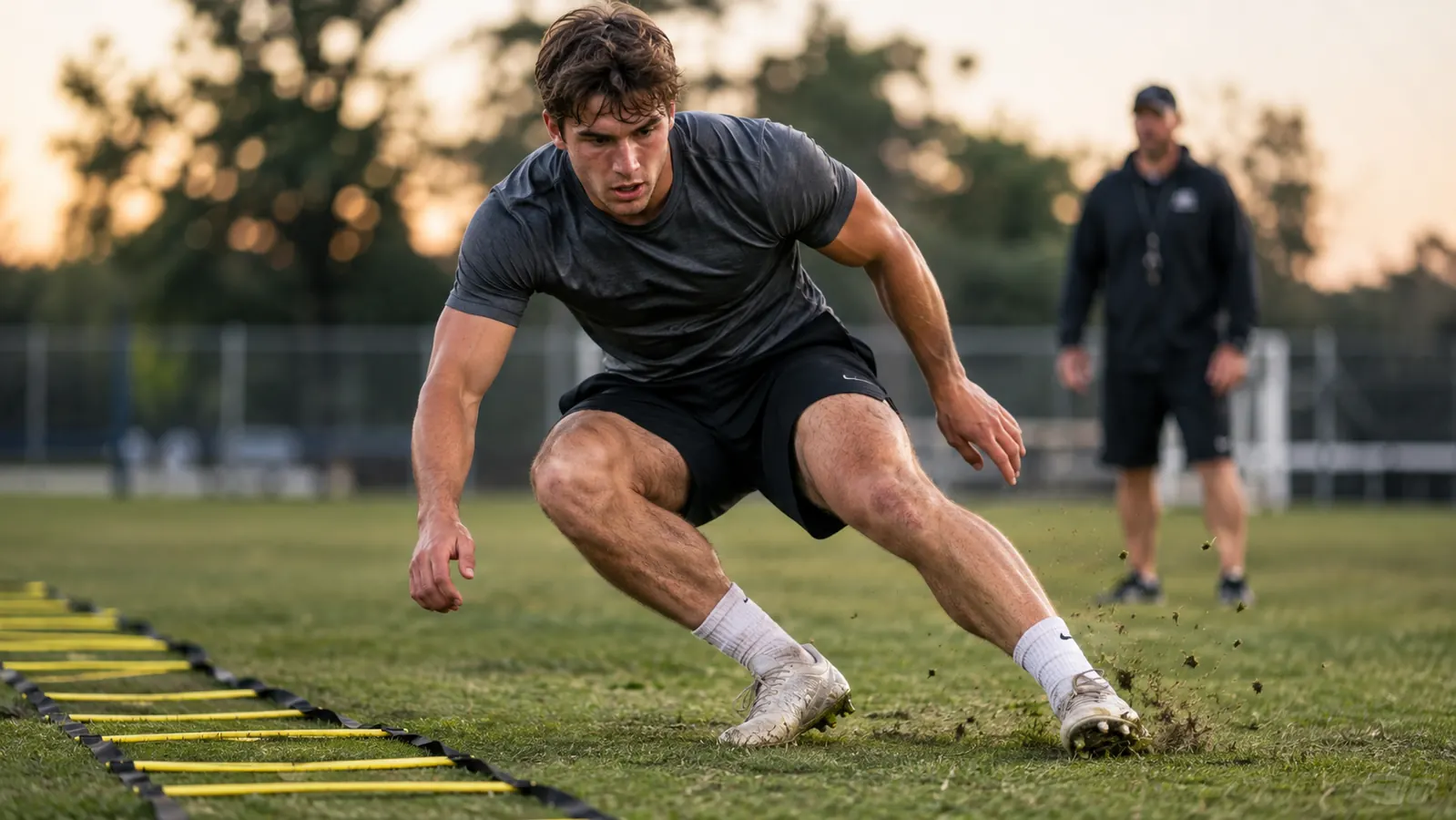
One foot per square. Walk it, then jog it, then run it. Eyes up, arms driving, one foot in each opening and nothing else. If the feet are loud, slow him down. Loud feet mean he is landing flat and putting the force into the grass instead of into the ground, and that is the opposite of what a linebacker needs when he has to redirect at the second level.
Two feet per square. Both feet in, both feet out, moving forward down the line. This is the pattern that teaches a player to stay low. Hips down, chest up, and watch what happens around the eighth rung when he gets tired, because that is the rep that tells you something. A player who stands tall here will stand tall into a block, and standing tall into a block is how you get knocked backward. This is also the pattern where I stop counting reps and start counting good reps. Ten clean rungs and then he stands up, the set is over. It does not matter that the plan on my phone said two sets of three. Fast and tall is a habit, and a habit does not come out of a player in a game because a coach wants it to. Two clean sets beat three sloppy ones every week of the season.
Lateral in-in-out-out. Face the ladder, step the lead foot in, follow with the trail foot, step out, repeat down the line and come back the other way. This is the closest thing on the ladder to a pass set, so it is the one I care about most for linemen. Keep the shoulders square and the feet under the hips. If he crosses his feet, stop him and reset the rep.
Step 3: Finish every rep with a change of direction
Ladder work by itself makes a player good at ladder work. The transfer happens in the five yards after the last rung, and that is the part most people skip, because it is the part that is hard to rehearse in a driveway. We learned that the boring way two seasons back. Our guys could run a clean ladder and then get to the second level on a Friday night and take four choppy steps to change direction, all that footwork and no exit. So now the exit is the drill. The last rung is not the finish line, it is the starting gun.
Every rep gets a finish. Sprint five yards out of the ladder. Plant and cut. Backpedal five yards and break on a hand signal. Rotate them through the block so the player never gets comfortable with one exit. The sprint teaches acceleration out of a tight space. The cut teaches the hips to drop and the feet to get underneath him. The backpedal is the one nobody enjoys and the one that shows up on every snap of a JV game.
Time the last rep of a set if you want a number to chase, but do not chase it every week. Feet first, then speed. A player who runs the ladder clean in 4.2 seconds is ahead of the player who runs it ugly in 3.8, and he will still be ahead of him in November.
Ladder work by itself makes a player good at ladder work. The transfer happens in the five yards after the last rung.
Step 4: Put the whole thing on the clock
Here is the version I actually run with our JV guys, start to finish, on a Tuesday in season.
Zero to four minutes is the warm-up and the two slow passes. Four to twelve is the three foundation patterns, two sets each, walking back to the start between sets so the rest is built in. Twelve to sixteen is the change of direction work: four reps of ladder into a plant and cut, alternating direction each rep. Sixteen to nineteen is the finish, four sprints of five yards out of the last rung with a walk back. Nineteen to twenty is water and one reminder to keep the feet quiet next time.
If the block runs long, cut a set. Do not cut the warm-up and do not cut the finish, because those are the two parts that keep a 15-year-old healthy and the two parts he will try to skip when you are not watching. Twenty minutes is the ceiling, not the floor. A block that gets done twice a week beats a perfect block that gets done once. And keep the GHB ladder set up between sets rather than folding it, because the moment you start packing and unpacking it in the middle of a session, the session gets shorter and the excuses get longer.
Step 5: Progress one variable at a time
There are three dials on this workout: rung spacing, speed, and whether a ball is involved. Change one at a time and give each change two weeks. Weeks one and two, narrow spacing, slow clean feet, no ball. Weeks three and four, widen toward the full 15 inches and add the cut finish to every rep. Weeks five through eight, add a football or have a partner flash a hand signal mid-pattern so the player has to process something while his feet are moving.
A ball in the ladder is harder than it looks and it is the version that looks most like a football play. Ask a sophomore linebacker to catch a short toss while his feet are still moving through the last two rungs and you will find out in about four seconds whether the footwork is automatic or whether he is still thinking about it. Last spring we ran that version every Thursday for six weeks, and the only thing I changed in six weeks was when the toss came. Same ladder, same spacing, same number of reps. By the end of it he was catching the ball without slowing his feet, which is the whole point of the block.
Two or three sessions a week is plenty, and none of them the day before a game. In season, Tuesday and Thursday. Off-season, Monday, Wednesday, Friday with a rest day between each. This is a supplement to practice, not a replacement for it, and a player who is already doing ladder work at school does not need a second dose of the same thing in the driveway.
What Else Helps
Shoes and surface, first. Cleats on grass, turf shoes on turf, and not flat-soled sneakers on wet grass in the dark. Most of the rolled ankles I have seen in backyard training came from a kid in running shoes on a wet slope, not from the drill. If the only flat space you have is a driveway, do the patterns at walking speed and save the fast reps for the field.
Second, sleep and food. A player who slept five hours and ate nothing is not going to get faster at six in the morning, no matter what ladder he is running. The workout is 20 minutes. The other 23 hours and 40 minutes are doing more of the work than anybody in the house wants to admit.
Third, fix the stuff that shifts on him. If a player's pads are sliding around every time he cuts, the ladder is not the problem. Loose pads move the weight, the weight moves the hips, and the hips are the thing you are trying to train. A girdle that rides up on the second rep of every set will quietly wreck a good block, so get the fit right before you blame the drill.
Fourth, keep the thing where you can reach it. This is the part that decides whether a 20-minute block survives October. The GHB ladder folds down into the carrying bag it ships with, and the bag fits behind the seat of the truck or on a shelf in the garage next to the spare equipment bin. If getting it out takes two trips and a conversation with a tangled pile of extension cords, it does not get used. If it takes eight seconds, it gets used on a random Wednesday in November when practice gets rained out.
Twenty feet of ladder, one bag, one plan
Twelve plastic rungs, adjustable spacing up to 15 inches, a carrying bag, and a drills guide in the box. That is the whole 20-minute block, minus the grass.
Amazon Check Today's Price on Amazon →